

think I may have your problem, you have connected power to the spdif board at J13, the fifo main board supplies power to the spdif board when they are connected, you should not be powering it from j13 as well, hopefully its OK, it would seem so as it works with input, but it may be causing some problem with the power sequencing of the output or some other error, overvoltage perhaps.... 😱
so disconnect that and try again
it may not be THE problem, but its definitely A significant problem that needs rectifying =)
J13 is only there for when using the spdif board with another project.
so disconnect that and try again
it may not be THE problem, but its definitely A significant problem that needs rectifying =)
J13 is only there for when using the spdif board with another project.
- Optional DC input: J13 (do not use if interfaced with FIFO board)
its funny I saw it when you first posted the photos and it registered as odd, but obviously there was a faulty gate in my thought matrix 
think I may have your problem, you have connected power to the spdif board at J13, the fifo main board supplies power to the spdif board when they are connected, you should not be powering it from j13 as well, hopefully its OK, it would seem so as it works with input, but it may be causing some problem with the power sequencing of the output or some other error, overvoltage perhaps.... 😱
so disconnect that and try again
it may not be THE problem, but its definitely A significant problem that needs rectifying =)
J13 is only there for when using the spdif board with another project.
Thanks Qusp,
The advise of using it was Ian's. I am affraid my reading of the howto was not precise enough.
I disconnect it later in the evening, have a dedicated 3.3V tab on Doede's Dac for the WaveIO!
Let you know,
Ed
Thanks Qusp,
The advise of using it was Ian's. I am affraid my reading of the howto was not precise enough.
I disconnect it later in the evening, have a dedicated 3.3V tab on Doede's Dac for the WaveIO!
Let you know,
Ed
I did the change, could not wait!
Pity it's still not the solution....Sniff sniff.
I hope there are some more solutions in the bin. But mine was empty already.
I am getting the thought that maybe something is wrong/broken on the board.
Have to dive deeper, only don't know how,
Ed

Did You run the boards disconnected from the DAC with only one power connection; USB-in 2 USB-out?
As per last picture in the s/pdif manual.
As per last picture in the s/pdif manual.
ah OK well maybe its not a warning, just saying its not needed, rather than saying not to use it. not looking at the board right now, perhaps there is some protections to stop it feeding back over to the fifo main board, but I dunno seems an odd recommendation from Ian, unless there is some mechanism to sense there is external voltage being supplied
no S/pdif output from S/pdif Fifo extension board
Hi Qusp
I feel you assume that there is feeding of power into the board. That is not the case. It is a 5V dc output for feeding possible accesories. The strange thing is that in the manual on the board is written: "INPUT 5V DC"? But it is not. It has about 6V.DC on it.
But I am glad to have tried it.
The picture shows Ian's setup.
ah OK well maybe its not a warning, just saying its not needed, rather than saying not to use it. not looking at the board right now, perhaps there is some protections to stop it feeding back over to the fifo main board, but I dunno seems an odd recommendation from Ian, unless there is some mechanism to sense there is external voltage being supplied
Hi Qusp
I feel you assume that there is feeding of power into the board. That is not the case. It is a 5V dc output for feeding possible accesories. The strange thing is that in the manual on the board is written: "INPUT 5V DC"? But it is not. It has about 6V.DC on it.
But I am glad to have tried it.
The picture shows Ian's setup.
Attachments

Last edited:
S/pdif, no output on Fifo/S/pdif-out board
Hi TNT,
I did not try it. It's my folowing thing to do.
Keep you informed,
Thanks, Ed
Did You run the boards disconnected from the DAC with only one power connection; USB-in 2 USB-out?
As per last picture in the s/pdif manual.
Hi TNT,
I did not try it. It's my folowing thing to do.
Keep you informed,
Thanks, Ed
Hi Qusp
I feel you assume that there is feeding of power into the board. That is not the case. It is a 5V dc output for feeding possible accesories. The strange thing is that in the manual on the board is written: "INPUT 5V DC"? But it is not. It has about 6V.DC on it.
But I am glad to have tried it.
The picture shows Ian's setup.
Aha right yes I thought you were feeding it power, because it IS an input, but its only suppose to be used if you are using the spdif board with another design. when in use with the fifo the fifo sends the power across the flex cable into J10 along with some other signals and clock (actually not sure on the clock). but that conductor and power connection on that ribbon is connected to that J13 screw terminal, as its the same power rail. That is why it shouldnt be connected to an external power supply while connected to the fifo, as fifo is already supplying power to that same rail. are you with me?
so in your case you are able to use it as an output because the power from the fifo main board travels over the flex cable and then into J10, out through L1 and through J13 + terminal (where you pick it up), continues through another inductor, bypass cap, a 1000uf reservoir cap and then powers the rest of the board.
Last edited:

Aha right yes I thought you were feeding it power, because it IS an input, but its only suppose to be used if you are using the spdif board with another design. when in use with the fifo the fifo sends the power across the flex cable into J10 along with some other signals and clock. but that conductor and power connection on that ribbon, is in parallel to that J13 screw terminal, because its the same power rail, which is why it shouldnt be connected to an external power supply while connected to the fifo, as fifo is already supplying power to that same rail. are you with me?
so in your case you are able to use it as an output because the power from the fifo main board travels over the flex cable and then into J10, out through L1 and through J13 + terminal (where you pick it up), another inductor, bypass cap, a 1000uf reservoir cap and then powers the rest of the board.
You are right, just noticed. S/PDIF board do not need any external power supply when work with fifo. Your configuration already shorts the two power🙂.
In my configuration, J13 was used powering the XMOS. But I found you power both from your reg.
The s/pdif board should have s/pdif output on both bnc and opt if there is clock feed from J11.
Ian
Attachments

Last edited:
phew =) OK well we sorted that, but it still doesnt work does it Ed?, he disconnected and tried I think, that wouldnt be a fatal error though I wouldnt think? I was thinking it might have caused enough of a ground loop or disturbance that the spdif out wouldnt work, but wasnt thinking it was a death-blow. which as it turns out would have meant instant no questions asked warranty replacement =)
So, i'm going to bow out lest the 2 of us confuse the poor guy with cross-posting instructions.
night chaps!
aha LED indications signals of course.
wasnt initially looking at the board or visualising it properly, was thinking clocks would be better suited to the flex cable electrically
So, i'm going to bow out lest the 2 of us confuse the poor guy with cross-posting instructions.
night chaps!
aha LED indications signals of course.
wasnt initially looking at the board or visualising it properly, was thinking clocks would be better suited to the flex cable electrically
Last edited:
You are right, just noticed. S/PDIF board do not need any external power supply when work with fifo. Your configuration already shorts the two power🙂.
In my configuration, J13 was used powering the XMOS. But I found you power both from your reg.
The s/pdif board should have s/pdif output on both bnc and opt if there is clock feed from J11.
Ian
Hi Ian,
No, I was just powering the isolator from the Xmos(WaveIO) like you suggested. See your own picture. This is what I did.
From earlier postings and pictures you can see prcisely how I did it.
Alas with the clockfeed from J 11 there's no signal on the outputs. Just, as I
mentioned, static ticks. Something like a dead transistor or something.
Even with all inputs, I2S and S/pdif and clock connections removed, I have these ticks! So the problem is isolated to only the S/pdif board?
Regards, Ed
Attachments

so in your case you are able to use it as an output because the power from the fifo main board travels over the flex cable and then into J10, out through L1 and through J13 + terminal (where you pick it up), continues through another inductor, bypass cap, a 1000uf reservoir cap and then powers the rest of the board.[/QUOTE]
Hi Qusp
Thank you for the clear explanation!
But I changed it anyway. Feeding the WaneIO I2s isolator from the 1794DDac.
Anyhow AnnyHall still no succes. Something must be broken on the board. Don't know why and how.
TNT,
I tried your suggestion, disconnecting the dac and only using USB. No solution!
I have only irregular static ticks on the outputs, even with a totally isolated
S/pdif board.
Thanks for your help,
Ed
Hi Qusp
Thank you for the clear explanation!
But I changed it anyway. Feeding the WaneIO I2s isolator from the 1794DDac.
Anyhow AnnyHall still no succes. Something must be broken on the board. Don't know why and how.
TNT,
I tried your suggestion, disconnecting the dac and only using USB. No solution!
I have only irregular static ticks on the outputs, even with a totally isolated
S/pdif board.
Thanks for your help,
Ed
Did you try to connect your WaveIO direct to the FIFO via I2S u.fl connectors (bypassing the SPDIF)?
I can't see your wiring on the WaveIO isolator as it was blocked by the heat-shrinkable sleeve. Could you take a better photo?
I can't see your wiring on the WaveIO isolator as it was blocked by the heat-shrinkable sleeve. Could you take a better photo?
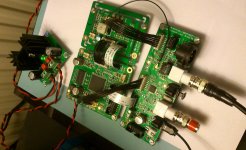
no output from FiFo S/pdif board, Update
Hi all!
First of all I should thank everybody for the lot of suggestions! Great forum!
After a lot of experimenting and trying things I found out that my outputs
are Working....
After changing the clocks(45.1584and 49.152) for the generic ones (22.xx and 24.xx) I get output. I tried the singleboard before as well, but that did not work out, don't now for what reason.
My problem of thinking was that I expected the same frequency of the input
device. The fact is that it outputs the frequency of the Fifoclocks. In other words, in my case with the higher F clocks it outputs double frequency.
So I could not get locks on the expected F.
Other words, when I play 44.1 material, I expect the same 44.1 on its output.
But with the double speed clocking this is not the case.
But I am glad that the Fifo is working at least.
Maybe someone has an idea if or how this could be solved.
Thanks again,
Ed
Hi Ian,
About everything is working fine. What NOT for heavens sake than?
Its the Ians Fifo-Out! I get no signal whatever I try to record from its output.
I tried a lot of things that came up, but I ran out of ideas.
Te thought that has left, is maybe feeding the USB-card from
the I2S backdoor ?
I included some pictures.
Somebody can advise?
Ed
Hi all!
First of all I should thank everybody for the lot of suggestions! Great forum!
After a lot of experimenting and trying things I found out that my outputs
are Working....
After changing the clocks(45.1584and 49.152) for the generic ones (22.xx and 24.xx) I get output. I tried the singleboard before as well, but that did not work out, don't now for what reason.
My problem of thinking was that I expected the same frequency of the input
device. The fact is that it outputs the frequency of the Fifoclocks. In other words, in my case with the higher F clocks it outputs double frequency.
So I could not get locks on the expected F.
Other words, when I play 44.1 material, I expect the same 44.1 on its output.
But with the double speed clocking this is not the case.
But I am glad that the Fifo is working at least.
Maybe someone has an idea if or how this could be solved.
Thanks again,
Ed
As we now may suggests that you might have missed something in the manual 😉 did you push the input selector button on the s/pdif board? It defaults to toslink- one push and you are on bnc.
Congrats to progress!
Congrats to progress!

Use this as divider by 2
The D Flip-flop Counter or Delay Flip-flop
The best filp-flop for the job is
http://as-electronic.net/download/potatosemi/PO74G74A.pdf
The D Flip-flop Counter or Delay Flip-flop
The best filp-flop for the job is
http://as-electronic.net/download/potatosemi/PO74G74A.pdf
forget the divider, it shouldnt be happening, fifo doesnt upsample, it doesnt have anything to do with the fifo clocks, because the sample rate for 44.1 stays 44.1.
one possibility, is that strange 'NOS' mode PCM1794 clocking scheme hes got going on there wont accept 512 or 1024 x FS, (less likely, doesnt like 32bit PCM in that mode). thats the only thing that changes when you use faster clocks, all the rest of the LRCK, Sdata all stay the same, that fits nicely with the single clock board not working as well, because the single clock board is stuck on 256x FS
something weird going on with your setup or dac. have you got another dac you can try?
see the filter in the pcm1794A probably doesnt know what the hell is going on in 'NOS' mode. which really isnt NOS, he just bypasses the digital filter in the PCM1794A and that could very well be causing it to have a weird very low max FS
one possibility, is that strange 'NOS' mode PCM1794 clocking scheme hes got going on there wont accept 512 or 1024 x FS, (less likely, doesnt like 32bit PCM in that mode). thats the only thing that changes when you use faster clocks, all the rest of the LRCK, Sdata all stay the same, that fits nicely with the single clock board not working as well, because the single clock board is stuck on 256x FS
something weird going on with your setup or dac. have you got another dac you can try?
see the filter in the pcm1794A probably doesnt know what the hell is going on in 'NOS' mode. which really isnt NOS, he just bypasses the digital filter in the PCM1794A and that could very well be causing it to have a weird very low max FS
Last edited:
- Home
- Source & Line
- Digital Line Level
- Asynchronous I2S FIFO project, an ultimate weapon to fight the jitter