
Wolfson WM8805 I2S to TDA1541A NOS
Much has been talked about the CS8414 receiver feeding the TDA1541A. Many thanks to ECDESIGN and others who has shared so much about optimizing the NOS TDA1541A.
There is a kit that utilizes the Wolfson WM8805 high performance S/PDIF transceiver.
This receiver provides low jitter recovery of S/PDIF supplied master clocks. That sounds good.
I built the kit and it was not choosy on the quality of transport, whether it was an expensive Denon SACD or a plain jane Pioneer DVD player.
You can find this DAC kit from Ebay; just do a search on WM8805 NOS.
One word of caution is the built quality of this kit is not top notch.
There could be some odd solder joints.
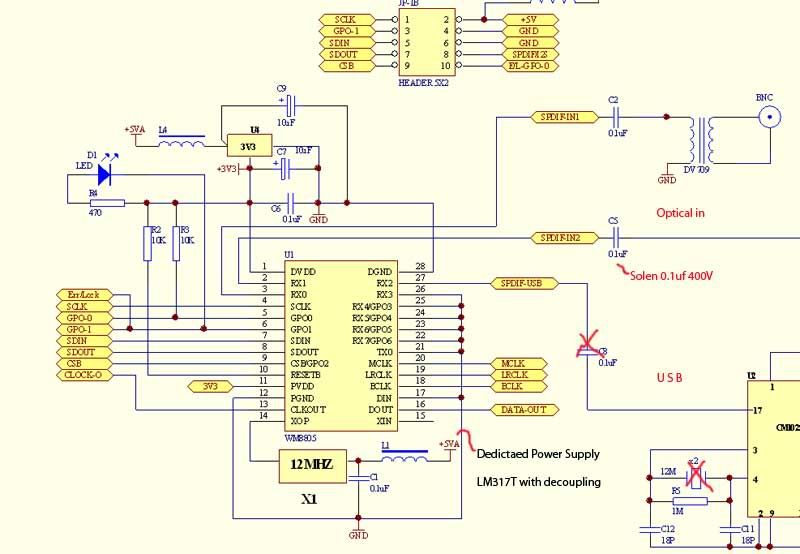
The 12Mhz crystal provides a reference clock for the phase lock loop in the WM8805.
The quality of the reference clock has great impact on the sound quality, even though it is not the master.
A simple solution is to give the TCXO a dedicated power supply and wave shaping using TTL.
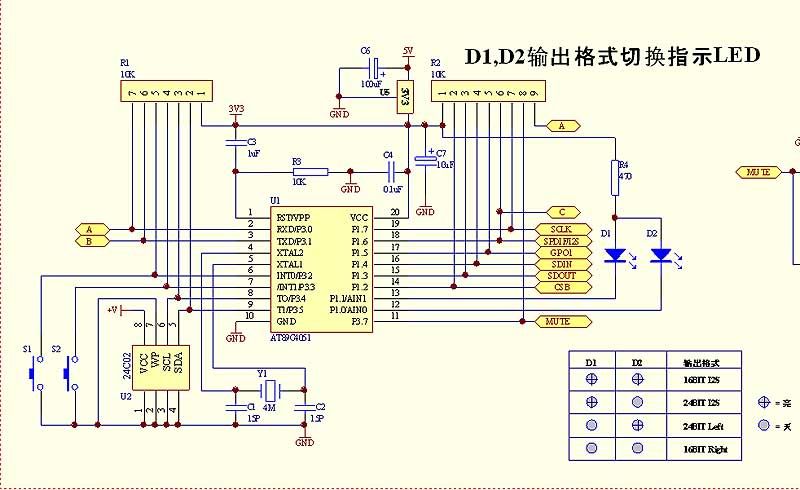
Here is the circuit diagram of the micro-controller selecting the input of Coaxial, Toslink or USB input for the WM8805.
You can also select 16 Bit I2S or other modes.
I am not using USB in the stereo, so I removed the USB interface to minimize interference.
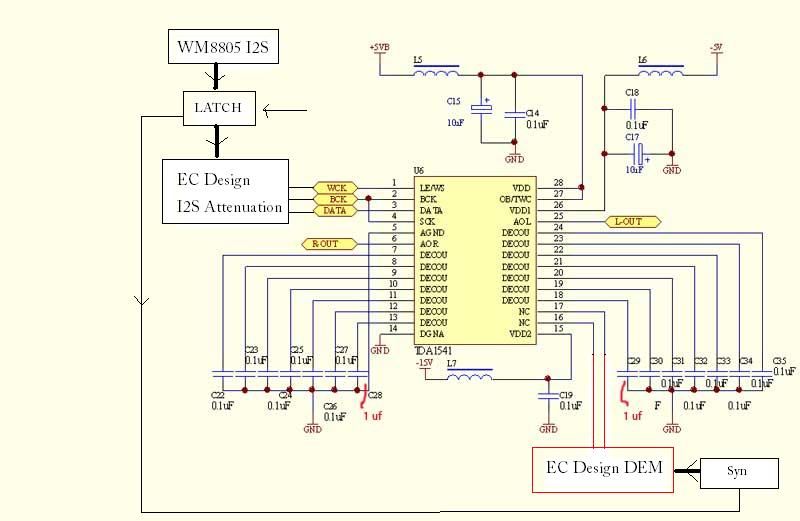
I had a lot difficulties to have the DEM circuit work.
Syn the DEM to WS derived from master clock worked.
I biased pin 16 to -15V using a 6V2 zener and ac coupled the signal.
This was the only way to get it to work.
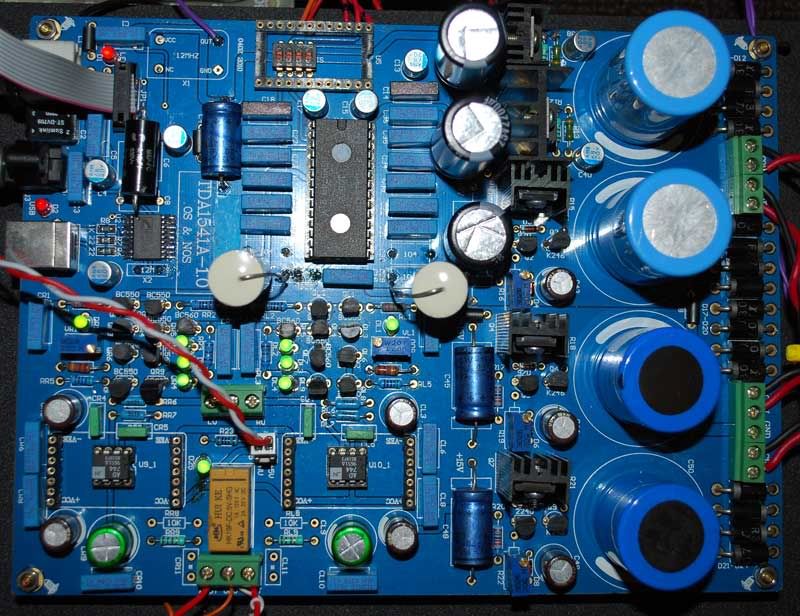
This is the main board with heavy gauge copper.
The I2S attenuation and latch was done on separate perf boards.
For the I2S attenuation, using only 3uH per arm gave good results.
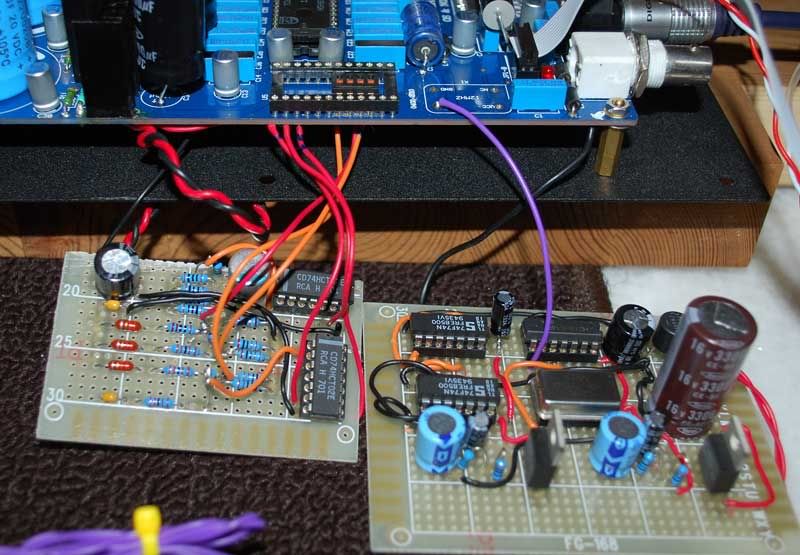
This board in stock form, a S1 crown 'appeared' to have better depth and focus than using a standard TD1541A.
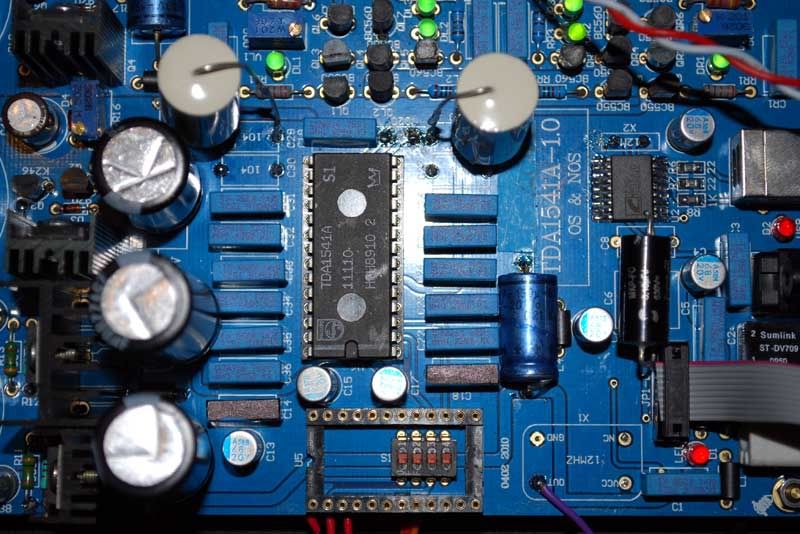
However, certainly female vocals can sound piercing and unbearable. (therefore the seller offers a HDAM unit, which is a discrete buffer.
The discrete buffer has a certain amount of attenuation at HF, thereby covering up the offensive HF performance.)
This is certainly an undesirable phenomenon when operating in OS mode.
I have verified that installing I2S attenuation solves this issue. (Ground bounce?)
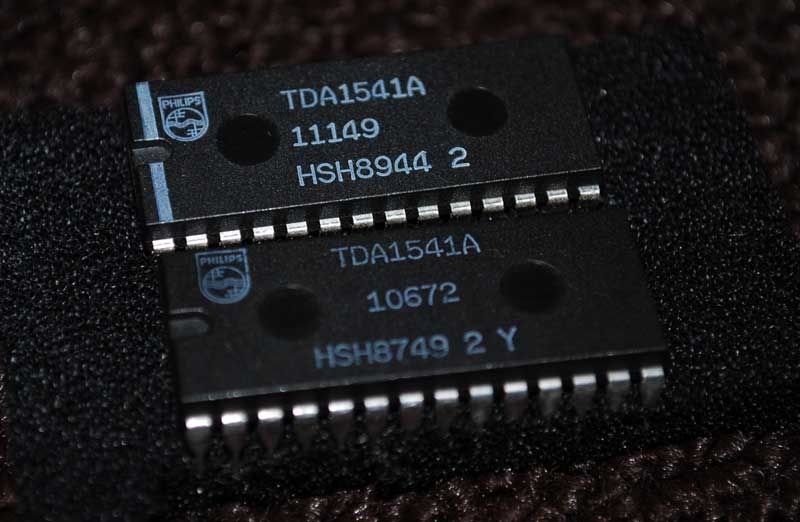
Somehow, after the mod, the standard TDA1541A at the top picture sound as good as the S1 crown chip. (FAKE Crown 😱 ? or the circuit is getting the TDA1541 work as designed.)
I am using the AD744 as the output buffer.
I have been using the AD744 with AD811 aka Walt Jung's trans impedance DC coupled pre-amp since my early Audio Amateurs days.
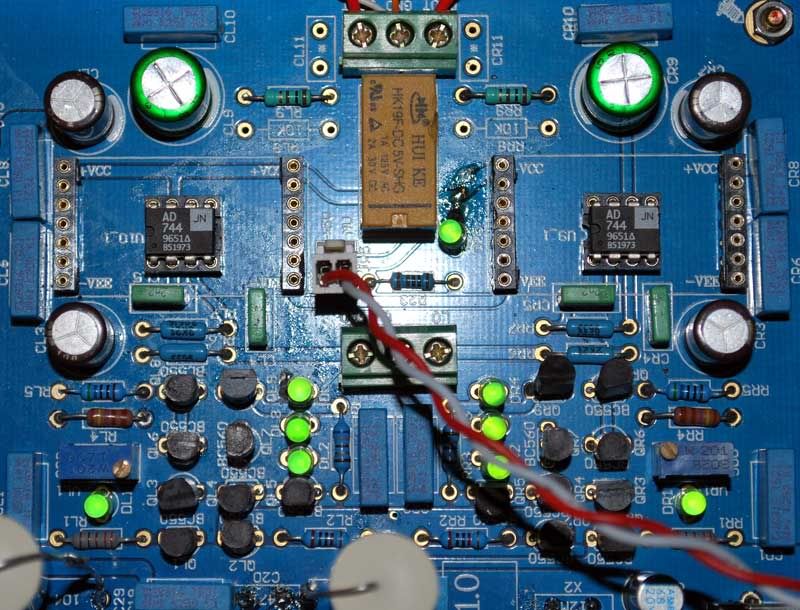
This stage is really up to individual's taste.
There are certainly alternative op-amps which others would prefer.
Personally, I find the AD744 detailed and musical in this setup.
At the end of the day, it is the music that we are after.
Never mind what the LeCroy scope says, if it sounds boring, it is boring.
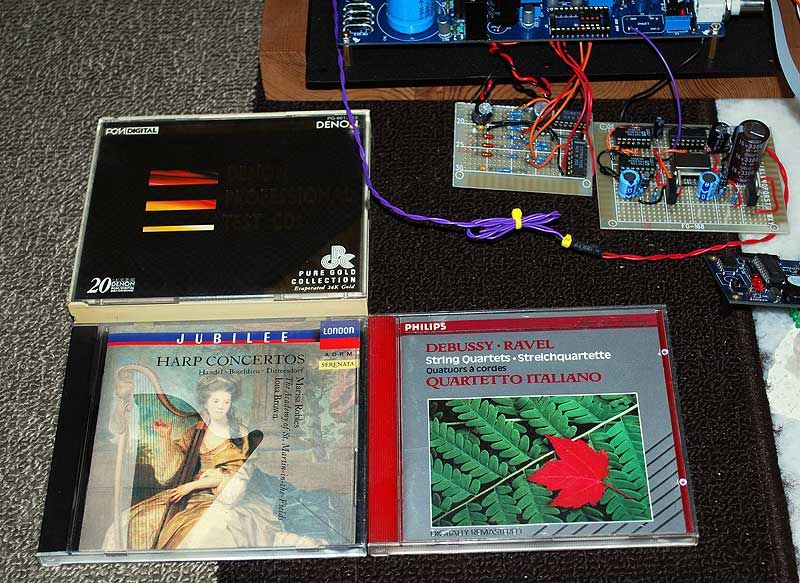
For years I have used this CD as a stringent test for many systems:
Harp Concertos by Marisa Robles (Nov-1990, London)
The harp can sound very muffled and vague, with no apparent imaging even on some very $$$$ setup.
But with the DAC, I can almost 'see' the harp right in front of me now.
Another good test CD on musicality is:
QUARTETTO ITALIANO DEBUSSY & RAVEL STRING QUARTETS
The ECDESIGN mods will make the DAC very revealing and yet very musical. Thank you ECDESIGN.
I really enjoy this DAC now, and hope you share the joy I have.
Cheers. 😉
Much has been talked about the CS8414 receiver feeding the TDA1541A. Many thanks to ECDESIGN and others who has shared so much about optimizing the NOS TDA1541A.
There is a kit that utilizes the Wolfson WM8805 high performance S/PDIF transceiver.
This receiver provides low jitter recovery of S/PDIF supplied master clocks. That sounds good.
I built the kit and it was not choosy on the quality of transport, whether it was an expensive Denon SACD or a plain jane Pioneer DVD player.
You can find this DAC kit from Ebay; just do a search on WM8805 NOS.
One word of caution is the built quality of this kit is not top notch.
There could be some odd solder joints.
The 12Mhz crystal provides a reference clock for the phase lock loop in the WM8805.
The quality of the reference clock has great impact on the sound quality, even though it is not the master.
A simple solution is to give the TCXO a dedicated power supply and wave shaping using TTL.
Here is the circuit diagram of the micro-controller selecting the input of Coaxial, Toslink or USB input for the WM8805.
You can also select 16 Bit I2S or other modes.
I am not using USB in the stereo, so I removed the USB interface to minimize interference.
I had a lot difficulties to have the DEM circuit work.
Syn the DEM to WS derived from master clock worked.
I biased pin 16 to -15V using a 6V2 zener and ac coupled the signal.
This was the only way to get it to work.
This is the main board with heavy gauge copper.
The I2S attenuation and latch was done on separate perf boards.
For the I2S attenuation, using only 3uH per arm gave good results.
This board in stock form, a S1 crown 'appeared' to have better depth and focus than using a standard TD1541A.
However, certainly female vocals can sound piercing and unbearable. (therefore the seller offers a HDAM unit, which is a discrete buffer.
The discrete buffer has a certain amount of attenuation at HF, thereby covering up the offensive HF performance.)
This is certainly an undesirable phenomenon when operating in OS mode.
I have verified that installing I2S attenuation solves this issue. (Ground bounce?)
Somehow, after the mod, the standard TDA1541A at the top picture sound as good as the S1 crown chip. (FAKE Crown 😱 ? or the circuit is getting the TDA1541 work as designed.)
I am using the AD744 as the output buffer.
I have been using the AD744 with AD811 aka Walt Jung's trans impedance DC coupled pre-amp since my early Audio Amateurs days.
This stage is really up to individual's taste.
There are certainly alternative op-amps which others would prefer.
Personally, I find the AD744 detailed and musical in this setup.
At the end of the day, it is the music that we are after.
Never mind what the LeCroy scope says, if it sounds boring, it is boring.
For years I have used this CD as a stringent test for many systems:
Harp Concertos by Marisa Robles (Nov-1990, London)
The harp can sound very muffled and vague, with no apparent imaging even on some very $$$$ setup.
But with the DAC, I can almost 'see' the harp right in front of me now.
Another good test CD on musicality is:
QUARTETTO ITALIANO DEBUSSY & RAVEL STRING QUARTETS
The ECDESIGN mods will make the DAC very revealing and yet very musical. Thank you ECDESIGN.
I really enjoy this DAC now, and hope you share the joy I have.
Cheers. 😉
Nimo_jon,
Can you post your latch circuit, I have purchase the WM8805 multiple input to spdif board from the same seller, and try to use the i2s out directly to my TDA1541 dac, and got a lot of noise from direct connection.
Thanks
Can you post your latch circuit, I have purchase the WM8805 multiple input to spdif board from the same seller, and try to use the i2s out directly to my TDA1541 dac, and got a lot of noise from direct connection.
Thanks
WM8805 I2S
Hi there
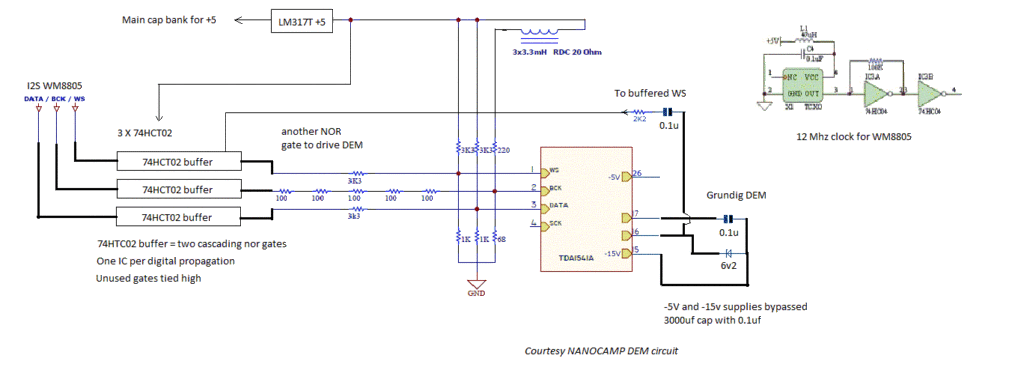
This is the latest simple DEM/Atten circuit for the WM8805. It is very simple and sounds awesome. Imaging is deep and musicality is involving.
Using a clocked latch (master clock from WM8805) did not sound as good as buffering the I2S lines. I suspect I added more jitter.
The clock feeding WM8805 has to be very stable. See the 74HC04 circuit attached.
The power supply for the I2S buffer and attenuation is provided by a separate LM317T adequately bypassed at the +5 output.
DEM is directly adopted from Grundig. Surprisingly this sounds better than any other setup I tried.
Hi there
This is the latest simple DEM/Atten circuit for the WM8805. It is very simple and sounds awesome. Imaging is deep and musicality is involving.
Using a clocked latch (master clock from WM8805) did not sound as good as buffering the I2S lines. I suspect I added more jitter.
The clock feeding WM8805 has to be very stable. See the 74HC04 circuit attached.
The power supply for the I2S buffer and attenuation is provided by a separate LM317T adequately bypassed at the +5 output.
DEM is directly adopted from Grundig. Surprisingly this sounds better than any other setup I tried.
I mentioned before the build quality of this kit is not very good. Therefore, it is good to check the functionality of this kit before any work is carried out. When I first powered up the kit, the +5 volt regulator had some cold joints somewhere. Redoing the joints near the +5 regulator solved the problem. Having said that this is a fairly bomb proof kit that can withstand a lot of abuse. 😉
Hi there
Any joy yet?
FYI I only use the optical link. Apparently there are some noise when using coaxial cable. Also, the DAC will sound horrible when you choose 16bit Right. So you have to use 16bit I2S indicated by D1 D2 both lighted up. Cheers.
Any joy yet?
FYI I only use the optical link. Apparently there are some noise when using coaxial cable. Also, the DAC will sound horrible when you choose 16bit Right. So you have to use 16bit I2S indicated by D1 D2 both lighted up. Cheers.

Hi, I bought some of these separate SPDIF modules with WM8805 for projects but I have my doubts about the 12 MHz oscillator being fed with 5V. IMO that should be 3.3V. What do you think of that ?
Hello
To be honest, I have no idea. There are no part numbers on the original TCXO.
I set aside the original TCXO that came with the kit. Although Wolfson data sheet mentions the internal Phase Lock Loop may allow the use of a cheap external crystal, it is imperative to use a high quality clock to get a decent sound.
I power a separately purchased 1ppm 12Mhz TCXO using a separate transformer, LM317T, adequate filtering, and a small inductance feeding it at 5V. Buffered thru Schmitt trigger using 74F TTL feeding the Wolfson, I can hear a distinctive improvement on sound quality. The definition, details and sound stage improved while the highs are more airy and smooth. Changing back to the standard TCXO (also at 5V) the sound became thinner and less refined. It was pretty obvious so I have no intention to bring back the original TCXO.
I have not tried 3.3V on the original TCXO. There is a 3,3V provision for the Wolfson, perhaps tapping that power can confirm if the TCXO needs to run at 3,3V?
regards
Jonathan
To be honest, I have no idea. There are no part numbers on the original TCXO.
I set aside the original TCXO that came with the kit. Although Wolfson data sheet mentions the internal Phase Lock Loop may allow the use of a cheap external crystal, it is imperative to use a high quality clock to get a decent sound.
I power a separately purchased 1ppm 12Mhz TCXO using a separate transformer, LM317T, adequate filtering, and a small inductance feeding it at 5V. Buffered thru Schmitt trigger using 74F TTL feeding the Wolfson, I can hear a distinctive improvement on sound quality. The definition, details and sound stage improved while the highs are more airy and smooth. Changing back to the standard TCXO (also at 5V) the sound became thinner and less refined. It was pretty obvious so I have no intention to bring back the original TCXO.
I have not tried 3.3V on the original TCXO. There is a 3,3V provision for the Wolfson, perhaps tapping that power can confirm if the TCXO needs to run at 3,3V?
regards
Jonathan
Attachments

The datasheet of the WM8805 says that max. input voltage of the XI input can be DVDD + 0.3V. DVDD is max. 5V but recommended is 3.3V so that is why I think 5V is not OK. It could be that the XI input is overdriven like this.
Which brand and type TCXO did you use ?
Which brand and type TCXO did you use ?
Last edited:
Hi there
Yes indeed. Data sheet clearly shows Voltage range digital inputs states: Absolute maximum rating at DVDD +0.3V.
The Wolfson master clock diagram indicates test conditions PVDD = 3.3V and DVDD =3.3V. The block diagram shows a Not gate in parallel with an external crystal. The logic levels are CMOS.... TTL driving high speed CMOS is tricky. I use 74HC04 (74HCT) which can take 2-6V and compatible with CMOS logic. Well I admit it did not cross my mind about the logic voltage levels.
I suppose we can get a reply from Wolfson's US technical support at: al_haun@comcast.net I am emailing him and lets see what is the reply. I would expect he would say its fine. If the 8805 dies just replace it 🙂 Anyway had been running the DAC for a long time and did not see any problems.
Yes indeed. Data sheet clearly shows Voltage range digital inputs states: Absolute maximum rating at DVDD +0.3V.
The Wolfson master clock diagram indicates test conditions PVDD = 3.3V and DVDD =3.3V. The block diagram shows a Not gate in parallel with an external crystal. The logic levels are CMOS.... TTL driving high speed CMOS is tricky. I use 74HC04 (74HCT) which can take 2-6V and compatible with CMOS logic. Well I admit it did not cross my mind about the logic voltage levels.
I suppose we can get a reply from Wolfson's US technical support at: al_haun@comcast.net I am emailing him and lets see what is the reply. I would expect he would say its fine. If the 8805 dies just replace it 🙂 Anyway had been running the DAC for a long time and did not see any problems.
Replacing SMD devices is definitely not my hobby if combined with crappy PCB material and PCB tracks coming loose.
I try to design stuff a way it won't break easy so I pay attention to matters as these. I suppose the reply will be to use 3.3V oscillators though I hope the 5V version is OK as those are easy to find (for acceptable prices too).
I try to design stuff a way it won't break easy so I pay attention to matters as these. I suppose the reply will be to use 3.3V oscillators though I hope the 5V version is OK as those are easy to find (for acceptable prices too).
Last edited:
I wouldn't worry too much about it. For a 5V version it can be a clipped sine wave or HCMOS output; its a low V resonant output. If there really is an issue, the seller won't go very far with the ranges of kits offered using the 8805. After running it for hundreds of hours, I am still enjoying the music.
I may lower the voltage to 3.3V with a 3.3V TCXO to give it a try. Let see how it goes.
I may lower the voltage to 3.3V with a 3.3V TCXO to give it a try. Let see how it goes.
No worries but I like to keep it that way 😉 No 3.3V 12 MHz pin compatible versions on Ebay..... If you find some please let me know. I could only find SMD versions. The 5V version only allows 5% lower voltage.
Last edited:
Not easy to find small quantity order for 3.3V TXCO.
An apps guy in the company told me large scale CMOS chips usually have LS TTL compatible IO pins, so we can drive them directly.
Why not adopt the Clock buffer I showed? Using the CMOS 74HC04 we can lower the supply voltage to 3.3V (minimum Vss =2V). The original TCXO can still be powered by +5V (7805 or better), with a 47uH series inductance for supply isolation. Two 74HC04 gates suffice to form a good clock buffer with improved waveform from TCXO direct. 74HC14 works too.
I changed the LM317T to variable output to get 3.3V for the clock buffer. It works with the 8805. With regards to the sound, I couldn't hear any difference from 3.3V or 5V.
Note that I am using the HCT gates (one gate from one chip) to buffer the I2S lines, to drive the attenuation network and feed the TDA1541A. So the 8805 is not doing a lot of work driving the passive network/DAC. That works well too.
An apps guy in the company told me large scale CMOS chips usually have LS TTL compatible IO pins, so we can drive them directly.
Why not adopt the Clock buffer I showed? Using the CMOS 74HC04 we can lower the supply voltage to 3.3V (minimum Vss =2V). The original TCXO can still be powered by +5V (7805 or better), with a 47uH series inductance for supply isolation. Two 74HC04 gates suffice to form a good clock buffer with improved waveform from TCXO direct. 74HC14 works too.
I changed the LM317T to variable output to get 3.3V for the clock buffer. It works with the 8805. With regards to the sound, I couldn't hear any difference from 3.3V or 5V.
Note that I am using the HCT gates (one gate from one chip) to buffer the I2S lines, to drive the attenuation network and feed the TDA1541A. So the 8805 is not doing a lot of work driving the passive network/DAC. That works well too.
Nimo_jon,
Would you have the full schematics from post #1, especially the WM8805 and associated switching circuit? I noticed there is more in the images linked that is cut off.
I purchased a converter module using the same circuit (well almost) from same seller. But he does not seem to have schematic.
Thanks,
Mihai
Would you have the full schematics from post #1, especially the WM8805 and associated switching circuit? I noticed there is more in the images linked that is cut off.
I purchased a converter module using the same circuit (well almost) from same seller. But he does not seem to have schematic.
Thanks,
Mihai

fwiw, I also bought an ebay module like this (or identical to it). I'm in the process of mounting it in a box and then replacing its controller with my own (the LCDuino).
re: coax and noise; mine also has noise. when I used my squeezebox3 and opto-out all is well. use its coax-out and I get faint hum! I looked at the schematic and there is no dc block cap on the input and I'm used to having on on inputs. .01 or .1 or in that range. (on spdif outputs, I use pulse trafos and do not put any caps on the trafo wires; but on inputs, I usually do.) perhaps adding the cap would break that hum loop?
also I notice that there are 75ohm R's in places that don't make sense. the wm chip is not getting signals from far away; they're coming from the local (on my board) cmedia usb chip and also a diff-rx chip for coax and aes3/xlr (marked 'xrl', LOL!). those don't need caps or resistors, they should be local logic-level lines suitable to send directly (or slightly attenuated) to the WM chip.
I find the sound to be at least as transparent as the source and perhaps better (using sb3 as primary source). I'm pretty excited about this chip and plan to write some software drivers for it then maybe do my own board.
re: coax and noise; mine also has noise. when I used my squeezebox3 and opto-out all is well. use its coax-out and I get faint hum! I looked at the schematic and there is no dc block cap on the input and I'm used to having on on inputs. .01 or .1 or in that range. (on spdif outputs, I use pulse trafos and do not put any caps on the trafo wires; but on inputs, I usually do.) perhaps adding the cap would break that hum loop?
also I notice that there are 75ohm R's in places that don't make sense. the wm chip is not getting signals from far away; they're coming from the local (on my board) cmedia usb chip and also a diff-rx chip for coax and aes3/xlr (marked 'xrl', LOL!). those don't need caps or resistors, they should be local logic-level lines suitable to send directly (or slightly attenuated) to the WM chip.
I find the sound to be at least as transparent as the source and perhaps better (using sb3 as primary source). I'm pretty excited about this chip and plan to write some software drivers for it then maybe do my own board.

Hi guys, does anyone know how to configure mode-control pins of WM8805 just for single input SPDIF and 16bit I2S for TDA 1543? I mean for using RX0 input only. Just resistors instead of input-select controller.
- Status
- Not open for further replies.
- Home
- Source & Line
- Digital Line Level
- Wolfson WM8805 I2S to TDA1541A NOS