

Hi,
I have an Audiodigit Tripath 2020 based amp that is up and working well. Sounds wonderful. I mainly listen to it via AKG K1000 headphones.
Last weekend I decided to check the DC offset on the output. One channel was 0 but the other channel was about 65mv. Is that anything to be concerned about in terms of damaging my phones or other speakers?
Thanks a lot,
Paul
I have an Audiodigit Tripath 2020 based amp that is up and working well. Sounds wonderful. I mainly listen to it via AKG K1000 headphones.
Last weekend I decided to check the DC offset on the output. One channel was 0 but the other channel was about 65mv. Is that anything to be concerned about in terms of damaging my phones or other speakers?
Thanks a lot,
Paul

skippy said:65mA is a perfectly acceptable offset for an audio amplifier. It will cause only a few mA of current to flow and no damage.
Thanks Skippy. That is what I was hoping...
panomaniac said:Headphones don't work well with the Tripath chips except the K100s.
You should still put an 8 or 6 ohm resistor across the speaker terminals so that the output filter will work properly. It will also help drop the ultasonics going to the AKGs.
Thanks Panomaniac. Yup, I am using a 6ohm 10w resistor on the outputs. I am also finishing up a Hypex UCD180 for driving the K1000's. The jury is still out on which sounds the best. The 2020 has more detail but the Hypex has much better control especially in complex music. I am not using a resistor on the Hypex as it is supposed to not have a rising high frequency response into rising impedance...
XELB said:Why don't you use the trimmer in your Tripath board to control the DC Offset ?
My board came from www.autocostruire.com and as far as I know does not include any trimmers for adjusting offset.
http://www.autocostruire.com/catalog/product_info.php?cPath=42&products_id=257
I would be happy to be wrong

Best,
Paul

They don't come with an offset trimmer but you can wire up one up for each channel with two 10kohm pots, two 1Mohm resistors, and two 0.1uF caps. My Ref-T boards have provisions for the DC offset trimmer circuit
There's a schematic of how to do it in one of the Tripath datasheets. Can't remember which one though.
There's a schematic of how to do it in one of the Tripath datasheets. Can't remember which one though.
I don't think that voltage offset is enough to do anything either, IMO with its 120ohm impedance and pretty low sensitivity the k1000 is less susceptible to DC offset than most other things, perhaps less sensitive than some of the smaller high efficiency speaker drivers ???
But why I posted was that A couple of people have had problems with the k1000's dying with t-amps... so I was wondering if the tripath ultrasonics could damage a 120ohm driver if youre not using the parallel resistor? Although we can only guess at the k1000's impedance at these frequencies, I'm sure a few of you know more about the ultrasonics a t-amp puts out than I do... Could they put out enough ultrasonics to kill a high impedance driver? I would sure like an explanation as to these dying k1000's, considering i have a k1000 and a Charlize in the mail.
But why I posted was that A couple of people have had problems with the k1000's dying with t-amps... so I was wondering if the tripath ultrasonics could damage a 120ohm driver if youre not using the parallel resistor? Although we can only guess at the k1000's impedance at these frequencies, I'm sure a few of you know more about the ultrasonics a t-amp puts out than I do... Could they put out enough ultrasonics to kill a high impedance driver? I would sure like an explanation as to these dying k1000's, considering i have a k1000 and a Charlize in the mail.
I don't know why there is such a rush to use the T-amps with headphones. Because it's cheap? Really, there are better amps out their for headphone use.
As for ultrasonics, there is quite a bit left over in the signal. I have only measured one set of tweeters at 700kHz, but they were about 16 ohms. 4 ohms at normal frequencies. No idea what the K1000 do.
The T-amps NEED a resistor on the output if you're going to drive headphones. 8 or 6 ohms would be ideal. This load helps the output filter. See this graph. The line that heads for the sky at the top end is the unloaded response. That's what you'll get on headphones without that resistor.
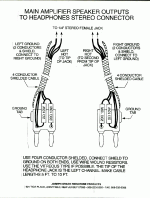
The image lucpes posted above is close to what I use for my amp testing headphone rig. An L-Pad. But use 8 ohms, not 20, as seen on the drawing.
As for ultrasonics, there is quite a bit left over in the signal. I have only measured one set of tweeters at 700kHz, but they were about 16 ohms. 4 ohms at normal frequencies. No idea what the K1000 do.
The T-amps NEED a resistor on the output if you're going to drive headphones. 8 or 6 ohms would be ideal. This load helps the output filter. See this graph. The line that heads for the sky at the top end is the unloaded response. That's what you'll get on headphones without that resistor.
The image lucpes posted above is close to what I use for my amp testing headphone rig. An L-Pad. But use 8 ohms, not 20, as seen on the drawing.
the problem is that a lot of headphone amps don't drive the k1k's that well...Because most headphones are around 100db/mw whereas the k1k's are 74db/mw or something like that (I cant find the manual at the moment).
I wouldn't use tripath amps with other headphones however...
I wouldn't use tripath amps with other headphones however...
panomaniac said:I don't know why there is such a rush to use the T-amps with headphones. Because it's cheap? Really, there are better amps out their for headphone use.
As for ultrasonics, there is quite a bit left over in the signal. I have only measured one set of tweeters at 700kHz, but they were about 16 ohms. 4 ohms at normal frequencies. No idea what the K1000 do.
The T-amps NEED a resistor on the output if you're going to drive headphones. 8 or 6 ohms would be ideal. This load helps the output filter. See this graph. The line that heads for the sky at the top end is the unloaded response. That's what you'll get on headphones without that resistor.
The image lucpes posted above is close to what I use for my amp testing headphone rig. An L-Pad. But use 8 ohms, not 20, as seen on the drawing.
I use a load resistor on the output of my T2020 amp and it sounds very good. I do not use one on my Hypex UCD180 amp because it is not supposed to have issues with a rising high frequency response into a high impedance load such as the K1000s present- 120ohms.
I tried the T-amp with my Sennheiser HD650s with appropriate wiring, grounds separated, but did not like the sound. Too bright. The K1000s are another matter. They are pretty amazing with the T2020 amp. They are also great with the Hypex but the amp needs a bit of tweaking to get the clarity of the lower powered 2020. As far as grip and handling complex passages it is much better however.
I think that folks are just trying to find the limits of this amazing little SI amp. I think that the anser is that class D is really here to stay. I am also thinking about trying one of the higher powered Tripath chips to see if I can get the clarity of the lower powered amp and the grip of the higher powered Hypex amp. It's been fun trying. After making tube amps for about 20 years I never thought that I would be making solid state amps and thinking that they were the cutting edge. Now what I would really like to see is a Hypex type amp using a tube input stage

Best,
Paul
- Status
- This old topic is closed. If you want to reopen this topic, contact a moderator using the "Report Post" button.
- Home
- Amplifiers
- Class D
- DC Offset on Tripath Amp...