
Hi again,
I am still much interested in this Tripath stuff. Few days ago, as I have been talking to a friend of mine, who is doing professional sound reinforcement services for live acts, clubs ...and I told him about class-T advantages and stuff, that he mostly did not know. But as we were talking, he asked me about typical class-T damping factor. So I told him, that as far as I know, these amps have DF about 300, maybe 400 (@ 8 ohm)(I have seen some test about it some time ago). He smiled... and told me that for him, any amp with DF below 800 is useless.
I think he needs high DF for driving those many-kW rated sets of subs, with as much precision as possible.
So now, I wanna kick his ***
I would love to build a class T amplifier with power about 2x800W (so, most likely based on TDA2500) which would have DF of 800 or more, at 8 ohm load.
I have done a small research and found out, that DF is very much related to the amound of negative feedback inside the amplifier. So, do I have to maximize the amount of negative feedback? How can I do this in class-T amplifier, where only feednack is that switching one, from the input of LC demodulating filter? Could I employ any other type of negative feedback, perhaps just like it is done in class AB, that means, feed the output signal from behind LC demodulator back to the input stage, thru some resistive network and filtering?
Any ideas and efforts to help are greatly appredicated!
I am still much interested in this Tripath stuff. Few days ago, as I have been talking to a friend of mine, who is doing professional sound reinforcement services for live acts, clubs ...and I told him about class-T advantages and stuff, that he mostly did not know. But as we were talking, he asked me about typical class-T damping factor. So I told him, that as far as I know, these amps have DF about 300, maybe 400 (@ 8 ohm)(I have seen some test about it some time ago). He smiled... and told me that for him, any amp with DF below 800 is useless.
I think he needs high DF for driving those many-kW rated sets of subs, with as much precision as possible.
So now, I wanna kick his ***
I would love to build a class T amplifier with power about 2x800W (so, most likely based on TDA2500) which would have DF of 800 or more, at 8 ohm load.
I have done a small research and found out, that DF is very much related to the amound of negative feedback inside the amplifier. So, do I have to maximize the amount of negative feedback? How can I do this in class-T amplifier, where only feednack is that switching one, from the input of LC demodulating filter? Could I employ any other type of negative feedback, perhaps just like it is done in class AB, that means, feed the output signal from behind LC demodulator back to the input stage, thru some resistive network and filtering?
Any ideas and efforts to help are greatly appredicated!
No, it won't.
These guys always try to have a shortest possible distance between the amplifier and speaker. In practical applications like live events, they have cases with amplifiers right behind the speakerbox sets, one for left channel, one for right. This way, they have these cables as short as 1 or 2 m. And, of course, they use thickest available cables, mostly 2x4qmm, sometimes even thicker.
So this cable has very, very small DF degradation effect.
Thanks for a good question, but this is not our problem right now...
These guys always try to have a shortest possible distance between the amplifier and speaker. In practical applications like live events, they have cases with amplifiers right behind the speakerbox sets, one for left channel, one for right. This way, they have these cables as short as 1 or 2 m. And, of course, they use thickest available cables, mostly 2x4qmm, sometimes even thicker.
So this cable has very, very small DF degradation effect.
Thanks for a good question, but this is not our problem right now...
A small suggestion.......
http://www.hypex.nl/docs/UcD700_datasheet.pdf
The dampingfactor will be >400 till 2000Hz. The UcD modules are known for a strong and solid bass response. Not only for High End application but also for PA application. This year some Professional Audio Companies will choose our Class-D modules because of the clean and deep bass response, instead of other Class-D brands.....
Regards,
Jan-Peter
http://www.hypex.nl/docs/UcD700_datasheet.pdf
The dampingfactor will be >400 till 2000Hz. The UcD modules are known for a strong and solid bass response. Not only for High End application but also for PA application. This year some Professional Audio Companies will choose our Class-D modules because of the clean and deep bass response, instead of other Class-D brands.....
Regards,
Jan-Peter
Thanks for an interesting suggestion.
However, although your class-D amplifier could have good bass response, i believe they can never beat class-T in full-range applications. And I do not want to design a subwoofer amp. I want to design an amplifier who will perform best in either bass and full-range amplification.
However, I have to achieve DF above 800, not 400, as you stated.
However, although your class-D amplifier could have good bass response, i believe they can never beat class-T in full-range applications. And I do not want to design a subwoofer amp. I want to design an amplifier who will perform best in either bass and full-range amplification.
However, I have to achieve DF above 800, not 400, as you stated.
However, although your class-D amplifier could have good bass response, i believe they can never beat class-T in full-range applications. And I do not want to design a subwoofer amp. I want to design an amplifier who will perform best in either bass and full-range amplification.
However, I have to achieve DF above 800, not 400, as you stated.
Sorry I don't wants to be rude, but an UcD can never beat Class-T in full range??? Please read first the Datasheet of the both amps, and put some special attention on;
THD of the Class-T above 1K and the UcD.
The true flat frequency response of the UcD, load independed (!) instead of the piek of the LC filter in the Class-T with different load (2-4-8-16 ohm). We even show a flat Frequency response in 1 ohm!!
You don't have to be worry about the lower DF as the 800. A wire of 2x4qm length 1 meter has already a DC resistance of 0.009. Thereby you have the internal wiring in the loudspeaker, four time the resistance of the Speakon connector. The Speakon will have 0.002-0.005. So at least you have a DC resistance > 0.02. What kind of output impedance the amplifier has in practice you will never come closer to 0.02!
One or our potential PA customers will test in a few weeks a dual UcD700 in bridge mode (2 amps bridged, in total 4 amps!) build in a dual 18" subwoofer....
When the DF of these amps were not ok, the PA manufacture would NEVER use the UcD700 on one of their 'most powerfull' subwoofer.....
Jan-Peter
Sorry I don't wants to be rude, but an UcD can never beat Class-T in full range??? Please read first the Datasheet of the both amps, and put some special attention on;
THD of the Class-T above 1K and the UcD.
The true flat frequency response of the UcD, load independed (!) instead of the piek of the LC filter in the Class-T with different load (2-4-8-16 ohm). We even show a flat Frequency response in 1 ohm!!
You don't have to be worry about the lower DF as the 800. A wire of 2x4qm length 1 meter has already a DC resistance of 0.009. Thereby you have the internal wiring in the loudspeaker, four time the resistance of the Speakon connector. The Speakon will have 0.002-0.005. So at least you have a DC resistance > 0.02. What kind of output impedance the amplifier has in practice you will never come closer to 0.02!
One or our potential PA customers will test in a few weeks a dual UcD700 in bridge mode (2 amps bridged, in total 4 amps!) build in a dual 18" subwoofer....
When the DF of these amps were not ok, the PA manufacture would NEVER use the UcD700 on one of their 'most powerfull' subwoofer.....
First, I have to ask you, are there any listening tests performed on your amplifiers in full range amplifiers?
Another question. Do you supply any pro-audio manufacturer with your modules for full-range amplifiers?
Also, please, keep in mind that it was not me who told that we need damping factor of 800. I can't even hear the difference between two amplifiers from same manufacturer with DF 400 and 800. I know that Speakon and wiring have some resistance which CAN degrade damping factor. So, please, you do not have to tell me.
The only thing I would like you to, is to help me with RB-TDA2500 DF maximization.
I hope that it is not too hard to understand.
I did some experiment on two conventional Class AB amps(monoblocks) , which was driving my subs. Really short speaker cables were used. Findings: varying the feedback-factor showed that there, in my opinion , was an optimal amount of negative feedback. This isn´t the same as maximal NFB. You can make an amp with very high open loop gain , then apply lots of NFB and get a very low appearent output impedance. But then I suspect that back- EMF from the speaker will make things worse .
A low output impedance is perhapes not the only way to good bass reproduction?
A low output impedance is perhapes not the only way to good bass reproduction?
Thanks for posting, this is a kind of post I have been awaiting.
How did you found out, where is that "right" point of feedback amount? How did the system behave at maximum NFB? What was worse at maximum NFB than at yours "optimal" NFB?
I will try to explain this from an easy point of view, because I like that
It is right, that all speakers in this world are not ideal resistances, but they have also a kind of "capability" to accumulate energy, so they behave as a complex load to their supply (amplifier). And, because, the speaker is basically an inductor, it tends to resist the supply either in pumping the current into, and getting it out of it.
The final results of this is, that we need a strong supply to keep the speaker cone moving how we want, and not to let him move how it wants. And my opinion is, that we have to overcome the results of accumulating energy by driving the speaker strong. SO we need a strong power supply, and strong connection between supply and speaker
Am I right or not?
So, what did you mean with "EMF from the speaker will make things worse"?
How did you found out, where is that "right" point of feedback amount? How did the system behave at maximum NFB? What was worse at maximum NFB than at yours "optimal" NFB?
I will try to explain this from an easy point of view, because I like that
It is right, that all speakers in this world are not ideal resistances, but they have also a kind of "capability" to accumulate energy, so they behave as a complex load to their supply (amplifier). And, because, the speaker is basically an inductor, it tends to resist the supply either in pumping the current into, and getting it out of it.
The final results of this is, that we need a strong supply to keep the speaker cone moving how we want, and not to let him move how it wants. And my opinion is, that we have to overcome the results of accumulating energy by driving the speaker strong. SO we need a strong power supply, and strong connection between supply and speaker
Am I right or not?
So, what did you mean with "EMF from the speaker will make things worse"?
I was under the impression that the relatively large resistance of the voice coil meant that having an extreamely high DF was pointless
http://www.audioholics.com/news/editorials/FiveAudioMyths.php
http://www.audioholics.com/techtips/audioprinciples/amplifiers/dampingfactor.php
http://www.audioholics.com/news/editorials/FiveAudioMyths.php
http://www.audioholics.com/techtips/audioprinciples/amplifiers/dampingfactor.php

Hello,
Since I worked in live pro audio for over 15 years in Europe and the USA, this is a subject I know a little about.
So my 2 cents worth:
Never in all my time as an audio engineer did I ever hear anyone but an amplifier salesman mention damping factor. All anyone talks about is power and reliability. That's why 3 amp companies rule the pro world, QSC, Crown and Crest.
Damping factor IS important, but most live engineers don't really care about it, or really know what it is. The guy who said "that for him, any amp with DF below 800 is useless" may have been reading too many sales brochures.
What can be done wrong in pro audio usually is. Don't count on short speaker cable runs with heavy gauge wire; it often is just the opposite. One common exception is the subs, where that amp rack is near the boxes. But not always. And amp racks are often only on one side of the stage, thus the long cable runs to the other side.
Powered speakers are becoming more and more common, so only a signal run is needed; the amp is right next to the driver. A good thing. I started using the Meyer powered series as soon as it came out. Love it.
As for the Tripath amps, don't be too in love with them. Yes, the little chips sound great, but the higher power chips do not have the same reputation. There was someone who posted here (or maybe AudioCircle) who worked for a PA amp manufacturer and designed some Tripath based amps. He would be the guy to find.
As for the Hypex modules, I have not heard them but am most impressed with what I have read about them, here and elsewhere. Very much worth a look/listen.
And why are you worried about the full range performance? What P.A. uses full range speakers or passive crossovers? Everything pro is actively filtered and multi-amped. Use the best amp for the frequency range.
End of
Since I worked in live pro audio for over 15 years in Europe and the USA, this is a subject I know a little about.
So my 2 cents worth:
Never in all my time as an audio engineer did I ever hear anyone but an amplifier salesman mention damping factor. All anyone talks about is power and reliability. That's why 3 amp companies rule the pro world, QSC, Crown and Crest.
Damping factor IS important, but most live engineers don't really care about it, or really know what it is. The guy who said "that for him, any amp with DF below 800 is useless" may have been reading too many sales brochures.
What can be done wrong in pro audio usually is. Don't count on short speaker cable runs with heavy gauge wire; it often is just the opposite. One common exception is the subs, where that amp rack is near the boxes. But not always. And amp racks are often only on one side of the stage, thus the long cable runs to the other side.
Powered speakers are becoming more and more common, so only a signal run is needed; the amp is right next to the driver. A good thing. I started using the Meyer powered series as soon as it came out. Love it.
As for the Tripath amps, don't be too in love with them. Yes, the little chips sound great, but the higher power chips do not have the same reputation. There was someone who posted here (or maybe AudioCircle) who worked for a PA amp manufacturer and designed some Tripath based amps. He would be the guy to find.
As for the Hypex modules, I have not heard them but am most impressed with what I have read about them, here and elsewhere. Very much worth a look/listen.
And why are you worried about the full range performance? What P.A. uses full range speakers or passive crossovers? Everything pro is actively filtered and multi-amped. Use the best amp for the frequency range.
End of
Hello all, especially Disney.
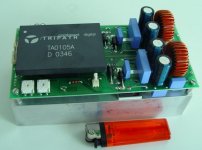
DF factor with Tripath is limited with filter coil and feedback type (pre filter), but bass control (and full range aplication)is not a problem, DF is only one parameter.... I have some practical experiences(about 4years) with TA104, TA105 and TDA2500, here is an example 1600W/4ohms module .
It is used in PA amps, in practical use with very good results in listening tests.
Try to look at www.bvaudio.sk (sorry, sites are only in slovak ), it is not to away ..
DF factor with Tripath is limited with filter coil and feedback type (pre filter), but bass control (and full range aplication)is not a problem, DF is only one parameter.... I have some practical experiences(about 4years) with TA104, TA105 and TDA2500, here is an example 1600W/4ohms module .
It is used in PA amps, in practical use with very good results in listening tests.
Try to look at www.bvaudio.sk (sorry, sites are only in slovak ), it is not to away ..
Attachments

And why are you worried about the full range performance? What P.A. uses full range speakers or passive crossovers? Everything pro is actively filtered and multi-amped. Use the best amp for the frequency range.
Actually, I am not worried about full-range performance. I am worried either about bass performance, and the rest of the band (sat) performance. I want this amp to be useable in both sub and sat powering applications.
DF factor with Tripath is limited with filter coil and feedback type (pre filter), but bass control (and full range aplication)is not a problem, DF is only one parameter.... I have some practical experiences(about 4years) with TA104, TA105 and TDA2500, here is an example 1600W/4ohms module .
It is used in PA amps, in practical use with very good results in listening tests.
I have been looking at your site. Actually, I found that you state DF of 400/1kHz/8 ohm. Is this really the measured value of your amp?
From that picture, I can see that the module is probably bridged. So, in a non-bridged module, theoretically, it could be possible to obtain a double DF, because output DC resistance (mainly inductor winding) would be only one, instead of two in bridged mode. Do you use STW34NB20s for power switching?
How much negative feedback do you use?
Yes, it is measured, but just behind output coil.I have been looking at your site. Actually, I found that you state DF of 400/1kHz/8 ohm. Is this really the measured value of your amp?
Really, it si bridged (Ub +-80V), DF doubling in non bridged aplications is not true, I dont know why.Used Mosfets are STW50NB20, it is on drivers limits (Qtotal).From that picture, I can see that the module is probably bridged. So, in a non-bridged module, theoretically, it could be possible to obtain a double DF, because output DC resistance (mainly inductor winding) would be only one, instead of two in bridged mode. Do you use STW34NB20s for power switching?
Schematic is same as recomended by Tripath (but it is , very layout sensitive, like others PWM amps).How much negative feedback do you use?
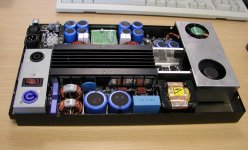
My Class-T Amp. Wiull develop 2x 1600w into 4R with DSP
Built my own gate driver circuits and use the TCA2002 which is Tripaths processor IC. We have a TCD6000 too which takes I2S digital audio.
Designing switching amps just takes a bit of care. I don't think there is any such thing as the ultimate sounding or best performing piece of audio equipment.
You just have to balance everything. Make it sound and measure well, make it reliable, compact and cost effective to manufacture.
Built my own gate driver circuits and use the TCA2002 which is Tripaths processor IC. We have a TCD6000 too which takes I2S digital audio.
Designing switching amps just takes a bit of care. I don't think there is any such thing as the ultimate sounding or best performing piece of audio equipment.
You just have to balance everything. Make it sound and measure well, make it reliable, compact and cost effective to manufacture.
Attachments
Hi Disney!
I mostly listen to find out which is the optional amount of NFB.
The original schematic had a resistor of about 12K for the part
of the dividing network I played with,the other resistor connected to earth is 464 ohm. Since I skipped the linestage of my preamp, and replaced it with a buffer stage, I needed more gain in the power amps. So 53K8 was the now put in instead of 12K.
When the monoblocks made their service as sub amps in an active sub system, I did some experiments e.g. to hear if the amount of feedback should be increased. Of course . at the same time, speaker Qts is affected by the output resistance of the amp and such things as the resistance of cables etc, and the ratio between them, but in this case increasing NFB too much , made me perceive the bass as clear and articulated, but a bit boring and not in great harmony with the higher notes.A bit "dead" perhapes?
Using the amps without feedback or with very little of it, made me feel that the bass suffered from lack of control and articulation. In this experiment ,I think I ended up somewhere around 32 Kohm for the feedback resistor.
I have also shorted the coil in the LR filter , as there is not much capacitance to be worried about. The theory is that the inductance of the coil makes up for more time-lag in the feedback system.
Eventually I sold these amps yesterday , and did some service on them
I kept the resistors as was, but promised to come back and try some other values, as they are now running fullrange.
As for the importance of a strong power supply, I agree. Connectors from the power supply should be as tight as possible ,useallly there is a lot of current flowing through them .
Some commercial designs , seems to be in need of service now and then , because there seem to be a preference for easy mounting and dismounting of connectors , instead of long time reliabillity.
As usual , we do- it -yourselfers has the edge
I mostly listen to find out which is the optional amount of NFB.
The original schematic had a resistor of about 12K for the part
of the dividing network I played with,the other resistor connected to earth is 464 ohm. Since I skipped the linestage of my preamp, and replaced it with a buffer stage, I needed more gain in the power amps. So 53K8 was the now put in instead of 12K.
When the monoblocks made their service as sub amps in an active sub system, I did some experiments e.g. to hear if the amount of feedback should be increased. Of course . at the same time, speaker Qts is affected by the output resistance of the amp and such things as the resistance of cables etc, and the ratio between them, but in this case increasing NFB too much , made me perceive the bass as clear and articulated, but a bit boring and not in great harmony with the higher notes.A bit "dead" perhapes?
Using the amps without feedback or with very little of it, made me feel that the bass suffered from lack of control and articulation. In this experiment ,I think I ended up somewhere around 32 Kohm for the feedback resistor.
I have also shorted the coil in the LR filter , as there is not much capacitance to be worried about. The theory is that the inductance of the coil makes up for more time-lag in the feedback system.
Eventually I sold these amps yesterday , and did some service on them
I kept the resistors as was, but promised to come back and try some other values, as they are now running fullrange.
As for the importance of a strong power supply, I agree. Connectors from the power supply should be as tight as possible ,useallly there is a lot of current flowing through them .
Some commercial designs , seems to be in need of service now and then , because there seem to be a preference for easy mounting and dismounting of connectors , instead of long time reliabillity.
As usual , we do- it -yourselfers has the edgeI don´t pretend that my experiment has any scientific value, but maybe some conclusions can be made .
Lowering feedback to some extent, made the treble sound better,in my opinion,removing it compleatly made the amps sound harsh. The bass benefited from some NFB, but not from much of it.
The constructor of the Copland CDA 823(CDP) says about the descrete output stage of the player , that to obtain both good macro- and microdynamics, you have to make a delicate mixture of global and local NFB.
In a simplified world, maximal or minimal rules, but in the real world we are more or less confused of what really matters.
Thus , I see statements as the one about the necessity of a high damping factor as just one more simplification, probably meant to aid in classyfing things and make choices more easy.....
To improve in and develop the art of audio , we might "just" make the right simplifications and "just" the right priorities , and questioning some old truths.Sounds quite possible,and class D
amp construction may in fact benefit from a not so long tradition?
So I might better be careful about; to indicate similarities between linear amps and class D amps?
.......we have the edge
Lowering feedback to some extent, made the treble sound better,in my opinion,removing it compleatly made the amps sound harsh. The bass benefited from some NFB, but not from much of it.
The constructor of the Copland CDA 823(CDP) says about the descrete output stage of the player , that to obtain both good macro- and microdynamics, you have to make a delicate mixture of global and local NFB.
In a simplified world, maximal or minimal rules, but in the real world we are more or less confused of what really matters.
Thus , I see statements as the one about the necessity of a high damping factor as just one more simplification, probably meant to aid in classyfing things and make choices more easy.....
To improve in and develop the art of audio , we might "just" make the right simplifications and "just" the right priorities , and questioning some old truths.Sounds quite possible,and class D
amp construction may in fact benefit from a not so long tradition?
So I might better be careful about; to indicate similarities between linear amps and class D amps?
.......we have the edge
- Status
- This old topic is closed. If you want to reopen this topic, contact a moderator using the "Report Post" button.
- Home
- Amplifiers
- Class D
- Class T - maximizing damping factor, any ideas?