

Can this Amp & DSP board be used for the Boominator Lite version?
Hi folks,
It's been a long while since I last posted. I am getting ready to build the Boominator Lite version as I have all the drivers. Since the original amp from 41Hz is no longer available, I came across this new board from Sure: 2 x 50 Watt Class D Audio Amplifier Board with Audio DSP - JAB3-250
It is available with a battery module (3x18650). I think you can wire two of these in serial to get 22V. Would it be enough to run the Boominator Lite?
Any insight would be greatly appreciated? Thanks
-Nelton
Hi folks,
It's been a long while since I last posted. I am getting ready to build the Boominator Lite version as I have all the drivers. Since the original amp from 41Hz is no longer available, I came across this new board from Sure: 2 x 50 Watt Class D Audio Amplifier Board with Audio DSP - JAB3-250
It is available with a battery module (3x18650). I think you can wire two of these in serial to get 22V. Would it be enough to run the Boominator Lite?
Any insight would be greatly appreciated? Thanks
-Nelton
Attachments


I came across this nice little device too, with the battery module it reminds me on the cAMP by GMarsh.
With integrated Bluetooth it would be perfect, but you can wire up a CSR64A215 via I2S to the DSP expansion header.
With integrated Bluetooth it would be perfect, but you can wire up a CSR64A215 via I2S to the DSP expansion header.
What is a CSR64A215? It's not on Sure's site. Do you think two of the battery modules wired in series would be enough to power the Boominator Lite at close to max volume to last 8 hours?
Sure sells a bluetooth V4.0 board with APT-X for $22.90USD. Are there similar boards that are cheaper and still connect to the JAB3-250 w/ DSP?
Sure has some cheaper boards available: Sure Electronics' webstore Bluetooth Receiver Board
Two battery modules would push the input voltage to the limit. A 5S pack would be optimum for these boards.
Two battery modules would push the input voltage to the limit. A 5S pack would be optimum for these boards.
@drmord: I know what the CSR64A415 is now. I came across it on eBay. Thanks for your suggestion. I might try it out.
Hi all,
New here but been trying to read as much as possible and gain an understanding of everything.
A friend and I are going down the route of building a boominator - so far the ply and drivers (4 P-Audio HP-10W with 4 PHT-407N) have been purchased and are sat in the lock up and I've been tasked with sorting out the amp side of things.
I've read a lot of people using the maxamp20 and ta2020 and wondered if this is still the best route?
I'm fairly new to 12v systems however do have an ok to good understanding of sound and sound systems.
My main confusion is running the tweeters.
If the amp has two outputs rated at 4ohm and I hang 2 of the P Audios from each to give a 4ohm load, where am I wiring the tweeters in and how will the correct frequencies be sent to them.
Apologies for the noob questions - just becoming a bit lost!
New here but been trying to read as much as possible and gain an understanding of everything.
A friend and I are going down the route of building a boominator - so far the ply and drivers (4 P-Audio HP-10W with 4 PHT-407N) have been purchased and are sat in the lock up and I've been tasked with sorting out the amp side of things.
I've read a lot of people using the maxamp20 and ta2020 and wondered if this is still the best route?
I'm fairly new to 12v systems however do have an ok to good understanding of sound and sound systems.
My main confusion is running the tweeters.
If the amp has two outputs rated at 4ohm and I hang 2 of the P Audios from each to give a 4ohm load, where am I wiring the tweeters in and how will the correct frequencies be sent to them.
Apologies for the noob questions - just becoming a bit lost!
Bluetooth speaker build
Hi there,
Im gathering parts for a bluetooth speaker build, I thinking to use either 2 x 6,5" coaxial speakers or a 2.1 system with 2 x 6,5" 2 way system with a 6,5" subwoofer. Can anyone please point me in the direction of a decent amplifier board for this? What about this one? 2.1 Channels 68W * 2 + 150W * 1 HiFi LM3886 + 2SC5200 2SA1943 Power Tube Subwoofer Amplifier Board-in Amplifier from Consumer Electronics on Aliexpress.com | Alibaba Group
Hi there,
Im gathering parts for a bluetooth speaker build, I thinking to use either 2 x 6,5" coaxial speakers or a 2.1 system with 2 x 6,5" 2 way system with a 6,5" subwoofer. Can anyone please point me in the direction of a decent amplifier board for this? What about this one? 2.1 Channels 68W * 2 + 150W * 1 HiFi LM3886 + 2SC5200 2SA1943 Power Tube Subwoofer Amplifier Board-in Amplifier from Consumer Electronics on Aliexpress.com | Alibaba Group
Hi there,
Im gathering parts for a bluetooth speaker build...[/url]
Since you posted on this thread, you want a portable solution? Then forget that LM3886 board and look for class D board, like tpa3116. What kind of battery are you using? What impedances your speakers have?
Since you posted on this thread, you want a portable solution? Then forget that LM3886 board and look for class D board, like tpa3116. What kind of battery are you using? What impedances your speakers have?
I want it to be portable but 99,99% of the time it will be plugged in and I dont want to sacrifice sound for the portable option. I got a Focal 4ohm 2-way system that I can use for the project, but I will buy whatever gets reccomended here. Should I look for a 4ohm woofer?
I find a lot of DIY instructions using the tpa3116 and it shouldent be to difficult for me to find the parts but reading on the forum I see the LM3886 gets reccomended?
Last edited:
LM3886 is a great amp, but the TPA3118/TPA3116 is a better alternative for portable builds due to its lower power consumption. Lots of modules readily available on ebay.
LM3886 is a great amp, but the TPA3118/TPA3116 is a better alternative for portable builds due to its lower power consumption. Lots of modules readily available on ebay.
I dont rly care about power consumption as this thing will be plugged in most of the time, if I can manage to get 3 hours out of it I will be happy. I will spend a bit time on the carpentry here and I want to fill it with some nice hardware, but I will need someone to help me out with a shopping list so I know where to start.
Ok, then the LM3886. But I suggest that you create your own topic for this... because it doesn't have much to do with Boominator, or class D
So I have been wondering about something for some time now. The boominators dipole design boost low end performance, and gives some extra sensitivity due to magnet to magnet construction. But what if I only need the boominator to play from 200/250 hz and upwards? Can I get away with only one side and half the volume? What am I missing here?
The reason for this question is that I am trying to build a really compact PA system. And I am REALLY satisfied with the boominators performance. The more I listen to them, the more I love them. This summer I built 2 tham15s, and together with to halfinator boxes, we hosted a forest party for 110 people, and everyone was just baffled by the sound coming from those small boxes. But it was was to much work to carry this sound system 2 kilometers in to the forest. So now I am planning on making a smaller build, with some smaller subwoofers (for smaller parties yes), and back to my question. Can I chop off the other side of the boominator next time I build one if I adjust the xover accordingly?
Here's a picture of the project.
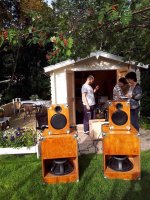
The reason for this question is that I am trying to build a really compact PA system. And I am REALLY satisfied with the boominators performance. The more I listen to them, the more I love them. This summer I built 2 tham15s, and together with to halfinator boxes, we hosted a forest party for 110 people, and everyone was just baffled by the sound coming from those small boxes. But it was was to much work to carry this sound system 2 kilometers in to the forest. So now I am planning on making a smaller build, with some smaller subwoofers (for smaller parties yes), and back to my question. Can I chop off the other side of the boominator next time I build one if I adjust the xover accordingly?
Here's a picture of the project.
So I have been wondering about something for some time now. The boominators dipole design boost low end performance, and gives some extra sensitivity due to magnet to magnet construction. But what if I only need the boominator to play from 200/250 hz and upwards? Can I get away with only one side and half the volume? What am I missing here?
The reason for this question is that I am trying to build a really compact PA system. And I am REALLY satisfied with the boominators performance. The more I listen to them, the more I love them. This summer I built 2 tham15s, and together with to halfinator boxes, we hosted a forest party for 110 people, and everyone was just baffled by the sound coming from those small boxes. But it was was to much work to carry this sound system 2 kilometers in to the forest. So now I am planning on making a smaller build, with some smaller subwoofers (for smaller parties yes), and back to my question. Can I chop off the other side of the boominator next time I build one if I adjust the xover accordingly?
Here's a picture of the project.
View attachment 702745
a little confused, you find the boominator too big, but then in your picture you suggest these massive subwoofers?
But ignoring that issue, yes you can build anything you like, the thing about the dipole configuration is that it is the most compact way to mount two woofers and benefit from doubling the surface area and halving the impedance, and that's it, and that's not bad because that's 3dB each.
As far as the benefit of having the magnets interact with each other and bump up the sensitivity, I'm not really convinced.
Motor design is a pretty involved process and optimized for the voice coil and magnet gap, shoving another magnet at the back is pretty un-mathematical, who is to say that you're not making things worse? well those who have measure this, and as far as I know, nobody has. Gut instinct (well inverse square law basically) tells me that it probably doesn't matter either way.
Boominator maybe lacking bass
Hello,
I've taken my old boominator back to the workbench to do some measurements. I've always thought my boominator was missing some low-end repsonse. I did check the phase and wiring and it's correct.
I have attached a near-field measurement of the woofer.
Do you have a similar measurement i can compare to?
Ive done a leak-test by taping the bass-reflex with a hose through. I've found that the drivers are not air-tight, as i can "Suck" a plastic bag to the woofers. Is this normal?
Jens
Hello,
I've taken my old boominator back to the workbench to do some measurements. I've always thought my boominator was missing some low-end repsonse. I did check the phase and wiring and it's correct.
I have attached a near-field measurement of the woofer.
Do you have a similar measurement i can compare to?
Ive done a leak-test by taping the bass-reflex with a hose through. I've found that the drivers are not air-tight, as i can "Suck" a plastic bag to the woofers. Is this normal?
Jens
Attachments


You were under moderation like all new users. After a few more posts you'll be released into freedom. 😉
You were under moderation like all new users. After a few more posts you'll be released into freedom. 😉
Yea, I didn't get the warning before i made the quick-reply 😉
Explanation: When i posted from "Advanced" it didn't show the "moderator approvement message". It just went back to "Class D" without warning..
Thanks for approving 🙂
- Home
- Amplifiers
- Class D
- The Boominator - another stab at the ultimate party machine