

I have noticed that people (IE Brian and Peter) have tended toward component diodes in power supply kits for "gainclone" amps and was wondering what the benefit (if one exists) of these over pre-packaged bridge rectifiers was.
Most of the electronics stuff I do is for instrumentation, so I am still quite new to understanding the sonic implications of different electronic components in amplifiers.
Thanks for helping out the new guy!
David
Most of the electronics stuff I do is for instrumentation, so I am still quite new to understanding the sonic implications of different electronic components in amplifiers.
Thanks for helping out the new guy!
David
Thanks for the response, Tweeker!
Taking this one step further, in a non-regulated power supply, I was under the impression that most of the power draw would be from the capacitors, and that the diodes would be effectively masked-especially in the case of the snubberized unit where the caps are so large. I guess I am not seeing the benefit of soft recovery diodes when the output of these will be fed into caps where the recovery will be "buffered" (not sure if this is the right description) anyway.
As for using Schottky diodes, I am plain lost on that one. I would think the voltages we are using would be sufficiently high to nullify any benefit of Shottkys.
Knowing how many revisions that the chipamps have been through, I am sure there is a justification for the diodes, but I just don't get it quite yet.
Thanks again!
David
PS I could, of course, just use the diodes and be done with it (it's not like they cost that much) I just have a nagging feeling anytime I do something without understanding why!
Taking this one step further, in a non-regulated power supply, I was under the impression that most of the power draw would be from the capacitors, and that the diodes would be effectively masked-especially in the case of the snubberized unit where the caps are so large. I guess I am not seeing the benefit of soft recovery diodes when the output of these will be fed into caps where the recovery will be "buffered" (not sure if this is the right description) anyway.
As for using Schottky diodes, I am plain lost on that one. I would think the voltages we are using would be sufficiently high to nullify any benefit of Shottkys.
Knowing how many revisions that the chipamps have been through, I am sure there is a justification for the diodes, but I just don't get it quite yet.
Thanks again!
David
PS I could, of course, just use the diodes and be done with it (it's not like they cost that much) I just have a nagging feeling anytime I do something without understanding why!
The bigger your capacitor bank the greater your problems are actually. The diodes conduct in shorter spikes and make more noise. Its difficult for the capacitors to shunt this noise to ground. The Schottkys are desirable more for thier good behavior than because of low foward voltage drop.


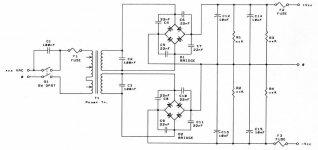
Nordic said:have any of you tried the 22nf caps over the bridges? I built a PSU like that, but I keep blowing the amp so I don't know what it sounds like...
What are you talking about...of course you know what the amp sounds like....
Boom..

(Sorry, just hadta...)
Cheers, John
- Status
- This old topic is closed. If you want to reopen this topic, contact a moderator using the "Report Post" button.
- Home
- Amplifiers
- Chip Amps
- Component Diodes vs. Bridge Rectifiers