
Hello
I have been wondering. If I have a potentiometer/attenuator in the usual configuration as a voltage divider in front of the op-amp input and there is also an input cap (series) and a shunt resistor from the input to ground:
What is the impedance seen by the source? I presume it will be the pot value in parallel with the shunt resistor. Correct?
What happens to the DC offset of the amp when turning the pot the resistance from wiper/input pin to ground changes? At the other end of the pot the resistance reaches very low values. Wouldn't this unbalance the input impedances of the amp and therefore cause large DC offset at output?
Thanks,
Lauri
edit: If the second point is correct, is there any easy way out of it?
I have been wondering. If I have a potentiometer/attenuator in the usual configuration as a voltage divider in front of the op-amp input and there is also an input cap (series) and a shunt resistor from the input to ground:
What is the impedance seen by the source? I presume it will be the pot value in parallel with the shunt resistor. Correct?
What happens to the DC offset of the amp when turning the pot the resistance from wiper/input pin to ground changes? At the other end of the pot the resistance reaches very low values. Wouldn't this unbalance the input impedances of the amp and therefore cause large DC offset at output?
Thanks,
Lauri
edit: If the second point is correct, is there any easy way out of it?
Attachments
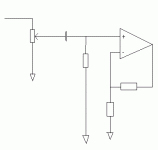
Here's the trick, the AC Impedance is the parallel combination of the input resistor and both halves of the pot, just as you suspected. But the DC impedance as seen from the input of the chipamp/opamp is only the input resistor. Why? Because of the input cap, which blocks DC. So what is the effect to the DC offset of changing the position of the pot? None.

With the pot set for zero output the source will see just the pot impedance. At max setting it will see pot in parallel with shunt R. In between it will see [input->wiper] in series with ( [wiper->ground] in parallel with shunt R). Make sense? Its easier to see if you draw it out as three resistors.
DC impedance it'll just see the full value of the POT, however, the AC impedance it'll see is:
lets call R1 resistance above the wiper, and R2 below the wiper, so R1 + R2 = Rpot, Xcap is the AC impedance of the cap which is frequency dependant. Xcap = 1/jwC;
R1 + ( R2 || (Rshunt + Xcap) )
If C is sufficiently large so that it's impedance is perhaps 1/10th or so of Rshunt, the it can be safely calculated as R1 + (R2 || Rshunt)
Which by the way, varies as you adjust R1, at 0-volume, you'll have Rpot as your input resistance, at full volume, you'll have Rpot || (Rshunt+Xcap)
--
Danny
lets call R1 resistance above the wiper, and R2 below the wiper, so R1 + R2 = Rpot, Xcap is the AC impedance of the cap which is frequency dependant. Xcap = 1/jwC;
R1 + ( R2 || (Rshunt + Xcap) )
If C is sufficiently large so that it's impedance is perhaps 1/10th or so of Rshunt, the it can be safely calculated as R1 + (R2 || Rshunt)
Which by the way, varies as you adjust R1, at 0-volume, you'll have Rpot as your input resistance, at full volume, you'll have Rpot || (Rshunt+Xcap)
--
Danny

Yes, there is a potential for problems. The DC impedance, looking back from the opamp input (which is a source of leakage current) to the audio source, will be all over the place. That will affect the DC offset, because the leakage current will induce a different voltage depending on the position (resistance) of the pot. Even though this voltage is small, it is amplified by the gain of the opamp.What if one does not have any input cap or input resistor, just a pot and a shunt resistor? any problems there?
- Status
- This old topic is closed. If you want to reopen this topic, contact a moderator using the "Report Post" button.