
Hi All,
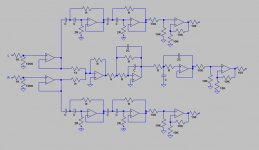
I've been thinking about doing this for a while. I wanna build something like the Keiga 2.1, except chipamp based. Targets:
-Single stereo input (RCA or 1/8")
-Summed (stereo>mono) lowpass filter to subwoofer amplifier.
-Highpass filter to bookshelves/mains/small computer speakers
-Linkwitz Riley 4th order crossovers all around.
-Single chipamp for each top (or a LM4780 half for each side)
-Chipamp based amplfiier for sub (2 parallel or 2 bridged, or 4 bridged-parallel).
Tentative crossover is attached. Uses 12 opamps, to be determined. Pulls a LOT from sound.westhost.com
I'm currently thinking point to point since I've never done PCB prototyping, but I dunno how well that'll work.
R and C are chosen for crossover frequency. Right now I'm thinking ~120-160 Hz, kind of high but I'm thinking about using CHR70's from Markaudio/CSS. Sub is some small 8"/10" (Tang Band or Dayton Reference or something from CSS)
Questions:
How necessary are the input and output buffers for the crossover? Assume fed directly into chipamp input.
For opamps, how necessary is regulation (other than just plain caps) on the power lines? Could I use rectifier>caps + bleedoff and use that for rails. Should I add a zobel? A zener? Some chip based rectifier (LM78XX or LM188/388)?
For the sub, I have an inverting summing amp, a MFB LP (inverting), and a Sallen Key (noninverting). Are there issues with cascading different filter topologies?
I'm thinking I can use chipamp kits for the amplifiers. For tops, probably two single 3785 kits, or a 4780 (for convenience).
I'm kinda torn on the sub amp. Choices:
-Parallel 4780
-Bridged 4780 (with DRV134)
-Bridged-Parallel 2x4780 (with DRV134).
Thoughts?
Thanks!
Justin
I've been thinking about doing this for a while. I wanna build something like the Keiga 2.1, except chipamp based. Targets:
-Single stereo input (RCA or 1/8")
-Summed (stereo>mono) lowpass filter to subwoofer amplifier.
-Highpass filter to bookshelves/mains/small computer speakers
-Linkwitz Riley 4th order crossovers all around.
-Single chipamp for each top (or a LM4780 half for each side)
-Chipamp based amplfiier for sub (2 parallel or 2 bridged, or 4 bridged-parallel).
Tentative crossover is attached. Uses 12 opamps, to be determined. Pulls a LOT from sound.westhost.com
I'm currently thinking point to point since I've never done PCB prototyping, but I dunno how well that'll work.
R and C are chosen for crossover frequency. Right now I'm thinking ~120-160 Hz, kind of high but I'm thinking about using CHR70's from Markaudio/CSS. Sub is some small 8"/10" (Tang Band or Dayton Reference or something from CSS)
Questions:
How necessary are the input and output buffers for the crossover? Assume fed directly into chipamp input.
For opamps, how necessary is regulation (other than just plain caps) on the power lines? Could I use rectifier>caps + bleedoff and use that for rails. Should I add a zobel? A zener? Some chip based rectifier (LM78XX or LM188/388)?
For the sub, I have an inverting summing amp, a MFB LP (inverting), and a Sallen Key (noninverting). Are there issues with cascading different filter topologies?
I'm thinking I can use chipamp kits for the amplifiers. For tops, probably two single 3785 kits, or a 4780 (for convenience).
I'm kinda torn on the sub amp. Choices:
-Parallel 4780
-Bridged 4780 (with DRV134)
-Bridged-Parallel 2x4780 (with DRV134).
Thoughts?
Thanks!
Justin
Attachments

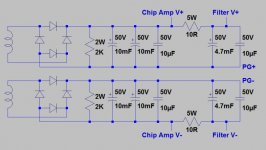
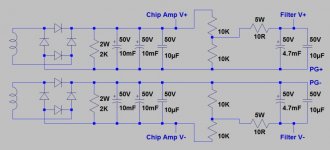
Strictly speaking regulators aren’t necessary for op-amps, they have excellent power supply rejection at lower frequencies, and a Pi filter can be used to smooth-out the upper harmonics from the bridge/capacitor sawtooth waveform. Just watch that the supply cannot exceed the op-amps maximum ratings (+/- 12 volts is usually safe, depending on the amps used). Using regulators will change the sound of the system, but for the better I’m not so sure anymore (when I was younger I was big into regulation, but I’m finding that I’m perfectly happy with Pi filters, just be sure to use big enough caps to get the line/load ripple down to manageable levels). One thing regulators will allow you to do is squeeze every last volt of headroom out of an amplifier. Doesn’t sound like this would be important in your case, as you plan to feed the power amps directly from the x-overs. Opinions will vary though.
If you’re feeding your active x-overs directly into your chip amp’s input, you may want to consider a muting relay for the output of either the x-overs or the chip amps themselves, as many op-amps will exhibit some really obnoxious sounds at power-up and power-down.
If you’re feeding your active x-overs directly into your chip amp’s input, you may want to consider a muting relay for the output of either the x-overs or the chip amps themselves, as many op-amps will exhibit some really obnoxious sounds at power-up and power-down.

Before sharing my thoughts on your ideas, understand that what you are thinking of building won't be easy to get right without a major investment in time and effort.
A better approach IMHO would be to simplify the design. A computer speaker/subwoofer system using two simple full-range speakers and a small sub is a very good start, but I'd recommend you avoid the overly complex crossover plan. Instead, a simple summer circuit followed by a single 2nd order low pass filter for the subwoofer, tuned to the natural roll-off of the main speakers would be more likely to get you there successfully. I also think it would make more sense to forget the parallel or bridge amp idea, and just use three single chip amp channels, one for each driver(you don't need a lot of power in this situation.)
I'd be happy to elaborate further at a later time, but right now I'm busy with my own over-blown, overly complex, project from hell(I'm actually finished with it, but there's this #$%&@! ground loop issue that I need to figure out.)
Cheers
A better approach IMHO would be to simplify the design. A computer speaker/subwoofer system using two simple full-range speakers and a small sub is a very good start, but I'd recommend you avoid the overly complex crossover plan. Instead, a simple summer circuit followed by a single 2nd order low pass filter for the subwoofer, tuned to the natural roll-off of the main speakers would be more likely to get you there successfully. I also think it would make more sense to forget the parallel or bridge amp idea, and just use three single chip amp channels, one for each driver(you don't need a lot of power in this situation.)
I'd be happy to elaborate further at a later time, but right now I'm busy with my own over-blown, overly complex, project from hell(I'm actually finished with it, but there's this #$%&@! ground loop issue that I need to figure out.)
Cheers
Moose-
I haven't seen too many of the DVC subs in the smaller sizes. I'll look into that though, thanks!
kaos-
Haven't looked much into Pi filters. This is the CLC filter right? Would you recommend this for the filter board only, or for the filter and amplifiers?
What range/sort/type of caps and inductors should I be looking at?
Michael-
I can see what you mean about the overly complex.
Issue I've generally had with fullrange mains (especially small ones) is that their amp tries to reproduce the lower frequencies, and you end up losing overall headroom. (does this sound correct? something like that). I have a similar set of speakers - two speakers and a sub - and when I don't highpass the mains, they start bottoming out with any decent amount of LF material.
I may consider second order though. Would LR2 work better, or would an asymmetrical configuration work better?
I don't think the bridge/parallel adds too much complexity to the design, since I can just use the audiosector LM4780 board and add a few resistors to it for either one. Main reason I'm doing the dual is because of the overall lower sensitivity of various subs, and the fact that I'll have two mains to one sub.
What's your current overly complex project?
Also, general question. What is the recommended wiring method for something like this (without PC board)? Straight point to point (seems like it would get ridiculously complicated with the number of filters)? Perfboard? Something like this: prepunched circuit board ?
Approx how much is a one-off set of PCBs (similar to chipamp ones)? 20 dollars apiece? 50 dollars apiece? Just kind of curious to see if it'd make sense.
If you have multiple PCBs in a system, how do you star ground? One star ground connected to each of the individual PCB grounds?
Thanks!
Justin
I haven't seen too many of the DVC subs in the smaller sizes. I'll look into that though, thanks!
kaos-
Haven't looked much into Pi filters. This is the CLC filter right? Would you recommend this for the filter board only, or for the filter and amplifiers?
What range/sort/type of caps and inductors should I be looking at?
Michael-
I can see what you mean about the overly complex.
Issue I've generally had with fullrange mains (especially small ones) is that their amp tries to reproduce the lower frequencies, and you end up losing overall headroom. (does this sound correct? something like that). I have a similar set of speakers - two speakers and a sub - and when I don't highpass the mains, they start bottoming out with any decent amount of LF material.
I may consider second order though. Would LR2 work better, or would an asymmetrical configuration work better?
I don't think the bridge/parallel adds too much complexity to the design, since I can just use the audiosector LM4780 board and add a few resistors to it for either one. Main reason I'm doing the dual is because of the overall lower sensitivity of various subs, and the fact that I'll have two mains to one sub.
What's your current overly complex project?
Also, general question. What is the recommended wiring method for something like this (without PC board)? Straight point to point (seems like it would get ridiculously complicated with the number of filters)? Perfboard? Something like this: prepunched circuit board ?
Approx how much is a one-off set of PCBs (similar to chipamp ones)? 20 dollars apiece? 50 dollars apiece? Just kind of curious to see if it'd make sense.
If you have multiple PCBs in a system, how do you star ground? One star ground connected to each of the individual PCB grounds?
Thanks!
Justin
For the op-amps I was thinking in terms of the CRC style Pi filter (4 caps and two resistors in a split supply). Easier than using inductors. The right values would depend on the specifics of the op-amps used and the rest of the power supply, but a crude rule of thumb is 470 uF per cap per op-amp. So in your circuit’s 12 op-amp case 4,700 uF caps and something around 10 ohm 5 watt resistors (while not needed for normal operation, using the bigger resistors gives the supply some tolerance for grazing shorts). It also usually helps to parallel the output caps with some smaller value like 22uF. Some people also tack on a small value film (around .1 uF) cap, but in my experience that’s a case-by-case sort of thing.
For typical power amps I just use a regular bridge/capacitor power supply. High current inductors are just too bulky for my taste, and resistors cut into the available power to some degree.
For typical power amps I just use a regular bridge/capacitor power supply. High current inductors are just too bulky for my taste, and resistors cut into the available power to some degree.
How small are smaller sizes? The Tangband W6-1139SH is a 6"-subwoofer with 2*4 Ohm voice-coils. It is fine in small CB enclosure. It yould be even better in a BR-box, but it needs extremely long reflex-tubes.aznshadoboy77 said:I haven't seen too many of the DVC subs in the smaller sizes. I'll look into that though, thanks!
That is one point. The other is that you can easily drive a small full-range speaker to its mechanical limits with low-frequent signals, so a high-pass filter is a good idea. With a chipamp the solution is simple. Use it AC coupled and choose Ci and Cin with values that give you the roll-off you desire. They provide a high-pass filter without the need for an additional crossover stage.aznshadoboy77 said:Issue I've generally had with fullrange mains (especially small ones) is that their amp tries to reproduce the lower frequencies, and you end up losing overall headroom. (does this sound correct?
If you want to get a lot of power out of a bridged or parallel configuration, don't use the LM4780, because you will run into heatsinking limits. Two LM3875 or LM3886 are the better choice then.aznshadoboy77 said:I don't think the bridge/parallel adds too much complexity to the design, since I can just use the audiosector LM4780 board
Don't worry too much about the power demands either. Your subwoofer will probably reach its mechanical limit much earlier than even a single chipamp runs out of steam with the right power supply.
The power supply looks similar to what I was thinking of. Dividers for applications like your x-overs probably aren’t the best choice, the load can vary too much. In that situation it’s better to use a separate transformer/bridge/filter for the x-over. If you have to run the low level stuff from the power amp’s main supply, then using regulators is the way to go in that case.
Power amp output muting circuits that give a slow turn on and fast turn off feature abound on the internet. You should be able to find one that’s adaptable for your application. If you prefer the relay to be at the x-over point, the same circuit should be usable there as well, with some minor modifications.
Power amp output muting circuits that give a slow turn on and fast turn off feature abound on the internet. You should be able to find one that’s adaptable for your application. If you prefer the relay to be at the x-over point, the same circuit should be usable there as well, with some minor modifications.
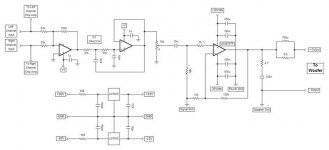
Do you intend to use this setup for near-field listening like typical computer speakers are used, or did you have something else in mind? If that is the case, and you plan to keep your hearing intact, a small full-range speaker in a sealed cabinet designed for that kind of use shouldn't bottom out. Keep in mind that nothing about this hobby of ours is set in stone, keeping it as simple as possible (but no simpler!) will generally give the most rewarding results with the least amount of effort invested.
Something like this is what I had in mind(below.)
I used a similar setup for several years, and was quite happy with it considering the minimal effort involved to build and tweek it.
As for my current project, I started a thread a few weeks ago (here: http://www.diyaudio.com/forums/showthread.php?s=&threadid=137716 ) to enlist the help of the fine folks here for ideas to track down and fix my on-going ground loop issue. I'm still working on getting pics and schematics posted, but my full time job, looking for a full time job, is the dominate factor in my life right now, so it's taking longer to "git'er dun" than I'd hoped.
Keep on keepin' on.
Something like this is what I had in mind(below.)
I used a similar setup for several years, and was quite happy with it considering the minimal effort involved to build and tweek it.
As for my current project, I started a thread a few weeks ago (here: http://www.diyaudio.com/forums/showthread.php?s=&threadid=137716 ) to enlist the help of the fine folks here for ideas to track down and fix my on-going ground loop issue. I'm still working on getting pics and schematics posted, but my full time job, looking for a full time job, is the dominate factor in my life right now, so it's taking longer to "git'er dun" than I'd hoped.
Keep on keepin' on.
Attachments
pacificblue said:
How small are smaller sizes? The Tangband W6-1139SH is a 6"-subwoofer with 2*4 Ohm voice-coils. It is fine in small CB enclosure. It yould be even better in a BR-box, but it needs extremely long reflex-tubes.
I don't see that one.. I only see the -SI version. And I can't seem to see any reference to dual voice coils? Maybe I'm missing it. I'll look around for other DVC subs though.
That is one point. The other is that you can easily drive a small full-range speaker to its mechanical limits with low-frequent signals, so a high-pass filter is a good idea. With a chipamp the solution is simple. Use it AC coupled and choose Ci and Cin with values that give you the roll-off you desire. They provide a high-pass filter without the need for an additional crossover stage.
I completely forgot about that possibility.. I was hoping for steeper rolloff than 1st order though. I'll have to consider that...
Random question, would it be possible to configure the LM3875 (or whatever chip) in a Sallen Key HP configuration? It's basically an opamp with high output capabilities that's not unity stable right? So as long as I include a decent amount of gain (above 10, and I was thinking in the range of 20), is there any reason it wouldn't work?
If you want to get a lot of power out of a bridged or parallel configuration, don't use the LM4780, because you will run into heatsinking limits. Two LM3875 or LM3886 are the better choice then.
I'll do two. For some reason I thought wiring would be easier with one, but I forgot about the thermal capabilities of the dual vs. single.
Don't worry too much about the power demands either. Your subwoofer will probably reach its mechanical limit much earlier than even a single chipamp runs out of steam with the right power supply.
A single chip can put out enough to run a 8" into mechanical limit? Didn't realize that...
kaos said:The power supply looks similar to what I was thinking of. Dividers for applications like your x-overs probably aren’t the best choice, the load can vary too much. In that situation it’s better to use a separate transformer/bridge/filter for the x-over. If you have to run the low level stuff from the power amp’s main supply, then using regulators is the way to go in that case.
I think this'll depend a lot on the transformer I'm using and the opamps (and min/max rail levels) that I find. I'll avoid the resistor divider though. If I use regulators, each opamp shouldn't take more than a couple mA right?
Power amp output muting circuits that give a slow turn on and fast turn off feature abound on the internet. You should be able to find one that’s adaptable for your application. If you prefer the relay to be at the x-over point, the same circuit should be usable there as well, with some minor modifications.
The one on Rod Elliot's page looks promising. Thanks!
Mostly nearfield, but ideally with the capability to get decently loud if necessary (movies and such, watched from across the room).Michael Bean said:Do you intend to use this setup for near-field listening like typical computer speakers are used, or did you have something else in mind? If that is the case, and you plan to keep your hearing intact, a small full-range speaker in a sealed cabinet designed for that kind of use shouldn't bottom out. Keep in mind that nothing about this hobby of ours is set in stone, keeping it as simple as possible (but no simpler!) will generally give the most rewarding results with the least amount of effort invested.
Something like this is what I had in mind(below.)
I used a similar setup for several years, and was quite happy with it considering the minimal effort involved to build and tweek it.
I'd like at least a little bit of highpass on the mains. Still debating between simple AC coupling (thanks pacificblue), separate active filtering (original plan), or possibly building Sallen Key into chip amp design.
What's the parallel LR on the output to the woofer? Some sort of additional filtering?
As for my current project, I started a thread a few weeks ago (here: http://www.diyaudio.com/forums/showthread.php?s=&threadid=137716 ) to enlist the help of the fine folks here for ideas to track down and fix my on-going ground loop issue. I'm still working on getting pics and schematics posted, but my full time job, looking for a full time job, is the dominate factor in my life right now, so it's taking longer to "git'er dun" than I'd hoped.
Keep on keepin' on.
Good luck with that!
Justin
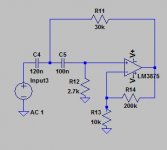
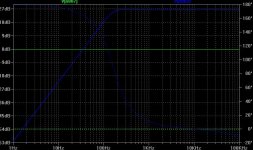
Would this work with the LM3875?
You'll have a massive offset of at least 800 mV, and quite probably more, with those values. To keep offsets to a minimum R13 needs to be coupled to ground through a capacitor, and R14 needs to equal R12. The 200K for R14 is also too large, it'll make for extra noise and stray pick-up, not to mention sensitivity to stray capacitance at the inverting input of the amp. The input at C4 will also need to be driven from a low source impedance, like a buffer, to even have a chance at stability. The non-inverting input may also need a "base stopper" resistor, as they're sometimes called. Not sure about that one though.
pacificblue said:Use it AC coupled and choose Ci and Cin with values that give you the roll-off you desire. They provide a high-pass filter without the need for an additional crossover stage.
- Status
- This old topic is closed. If you want to reopen this topic, contact a moderator using the "Report Post" button.
- Home
- Amplifiers
- Chip Amps
- Project Idea.. Computer Speaker Amp