

I am under the (mistaken??) impression that it is possible to use a line input transformer to convert a unbalanced signal to balanced.
i would like to do this so that i can bridge my chip amps.
however, when looking at the typical implementation of line input transformers:
cinemag line input transformer
it is not obvious to me how to do it.
i can see how i could use the transformer to invert (or conserve) the signal but i don't see how to get the original signal and the inverted out of the transformer at the same time. would i just pull it from the input?, use two transformers (one to invert and one to conserve)? attach the output of the transformer to the chip amps in opposite phase?
thanks for your help.
i would like to do this so that i can bridge my chip amps.
however, when looking at the typical implementation of line input transformers:
cinemag line input transformer
it is not obvious to me how to do it.
i can see how i could use the transformer to invert (or conserve) the signal but i don't see how to get the original signal and the inverted out of the transformer at the same time. would i just pull it from the input?, use two transformers (one to invert and one to conserve)? attach the output of the transformer to the chip amps in opposite phase?
thanks for your help.
unbalanced to balanced
depending on the specific transformer, you need two for each channel if they are 1:1 ratio, both transformers are wired together on the input side making sure of identical polarity, then the output of one trans can be the non-inverted in 1 = out leg one, in 2 =out leg two. the other trans you will wire the out two your amp opposite, in 1 = out two in 2 = out one. Basically the trans will invert your signal 180 degrees when wired opposite the other trans.
depending on the specific transformer, you need two for each channel if they are 1:1 ratio, both transformers are wired together on the input side making sure of identical polarity, then the output of one trans can be the non-inverted in 1 = out leg one, in 2 =out leg two. the other trans you will wire the out two your amp opposite, in 1 = out two in 2 = out one. Basically the trans will invert your signal 180 degrees when wired opposite the other trans.
thanks for the help. that definitely confirms what my oscilloscope and function generator were telling me.
it seems to me that using transformers for single ended to balanced conversion is a expensive option.
it seems to me that using transformers for single ended to balanced conversion is a expensive option.

okapi said:it seems to me that using transformers for single ended to balanced conversion is a expensive option.
Not really. That one is cheap and produces very satisfactory results: http://www.edcorusa.com/products/transformers/wsm/wsm10k-150.html
I tried it briefly with unbalanced to balanced signal conversion for LM4780 based amp and was not disappointed; actually the transformer produced cleaner signal than modified ML380 preamp.
I do conversion on S&B TX102 and it doesn't matter if I connect unbalanced or balanced inputs or outputs, the conversion works both ways with single windings on primary and secondary (no CT).
it seems to me that using transformers for single ended to balanced conversion is a expensive option.
Actually you are correct. A good performing transformer that doesn't loose out on the low end gererally runs about $90 a pop.
The Edcor transformers are a budget transformer that will come close in performance but cannot quite keep up to the more expensive brands.
I've tried about everything in large systems to balance or to combat noise problems and issolate when needed.
Added* I would try to find some Altec 15335 octal transformers.
They aren't made anymore but can be purchased reasonably and will deliver better performance than some of the cheaper transformers on the market. They are a 1:1 transformer and have a CMRR of 92db@60hz.

Take any cheap and small xformer and hook it up in a balanced "zero field"**) circuit (2 op-amps in instrumentation style, or a discrete equivalent). Gives stunning results and is used to a good extent in many pro gear...
**) look at this Lundahl datasheet for an unbalanced example of this:
http://lundahl.se/pdfs/datash/6404.pdf
- Klaus
**) look at this Lundahl datasheet for an unbalanced example of this:
http://lundahl.se/pdfs/datash/6404.pdf
- Klaus
thanks everyone.
i have been able to follow/understand just about all aspects of the comments.
peter i am a little confused about:
i am having trouble resolving your comment with:
klaus, i think i will give the "zero field" circuit a try. thanks for pointing it out. once i think i have it figured out, i'll post a schematic here that is specific to the components i am using to see what everyone thinks.
thanks again for everyone's feedback. i am at the "in laws" now in buffalo, ny then i'm off to toronto.
happy holidays.
i have been able to follow/understand just about all aspects of the comments.
peter i am a little confused about:
I do conversion on S&B TX102 and it doesn't matter if I connect unbalanced or balanced inputs or outputs, the conversion works both ways with single windings on primary and secondary (no CT).
i am having trouble resolving your comment with:
you need two for each channel if they are 1:1 ratio
klaus, i think i will give the "zero field" circuit a try. thanks for pointing it out. once i think i have it figured out, i'll post a schematic here that is specific to the components i am using to see what everyone thinks.
thanks again for everyone's feedback. i am at the "in laws" now in buffalo, ny then i'm off to toronto.
happy holidays.
Hi okapi,
Do you just want to convert unbalanced to balanced (i.e. single-ended to differential), or are you bent on using a transformer to do it?
If all you care about is the conversion, you could do that with two opamps. Basically, you just feed the single input to two differential amplifiers, one inverting and one non-inverting.
(I assume that you are wanting to bridge two already-complete, identical chipamp-based amplifiers. Otherwise, you could just use the chipamp chips in the bridged configuration, as in AN-1192 from national.com.)
If you are interested in using opamps, below are links to some example circuits, that you might be able to use (or adapt) to your purpose.
The first example is in Analog Devices' "Op Amp Applications Handbook", which is downloadable, in sections or complete, at http://www.analog.com/library/analogDialogue/archives/39-05/op_amp_applications_handbook.html . Look at Figure 3-42, in Section 3.
Another slightly-different way is shown in the right-hand sides of figures 1 and 2 on Page 96, in the "Printer Friendly" PDF link, at the link below:
http://www.edn.com/article/CA6339252.html
Another example is in Figure 2a in the "PDF Version" link at the following link:
http://www.edn.com/article/CA302234.html
And here are some construction notes and photos (and a schematic) by a guy who did it with just a DRV134 (or DRV135) chip, plus a link to his article about doing it with two opamps:
http://www.fivefish.net/diy/balanced2/default.htm
Of course, you could also do it with a single fully-differential opamp.
Do you just want to convert unbalanced to balanced (i.e. single-ended to differential), or are you bent on using a transformer to do it?
If all you care about is the conversion, you could do that with two opamps. Basically, you just feed the single input to two differential amplifiers, one inverting and one non-inverting.
(I assume that you are wanting to bridge two already-complete, identical chipamp-based amplifiers. Otherwise, you could just use the chipamp chips in the bridged configuration, as in AN-1192 from national.com.)
If you are interested in using opamps, below are links to some example circuits, that you might be able to use (or adapt) to your purpose.
The first example is in Analog Devices' "Op Amp Applications Handbook", which is downloadable, in sections or complete, at http://www.analog.com/library/analogDialogue/archives/39-05/op_amp_applications_handbook.html . Look at Figure 3-42, in Section 3.
Another slightly-different way is shown in the right-hand sides of figures 1 and 2 on Page 96, in the "Printer Friendly" PDF link, at the link below:
http://www.edn.com/article/CA6339252.html
Another example is in Figure 2a in the "PDF Version" link at the following link:
http://www.edn.com/article/CA302234.html
And here are some construction notes and photos (and a schematic) by a guy who did it with just a DRV134 (or DRV135) chip, plus a link to his article about doing it with two opamps:
http://www.fivefish.net/diy/balanced2/default.htm
Of course, you could also do it with a single fully-differential opamp.
The transformer is the best way to balance because it provides a higher CMRR than an op amp or other SS circuit is capable of.
You can of course use either transformers to balance/unbalance or a op amp circuit or a number of other ways.
If you are interested in a circuit just to bridge to identical chip amps or other amps period I will try to attach something here.
You can of course use either transformers to balance/unbalance or a op amp circuit or a number of other ways.
If you are interested in a circuit just to bridge to identical chip amps or other amps period I will try to attach something here.
Attachments
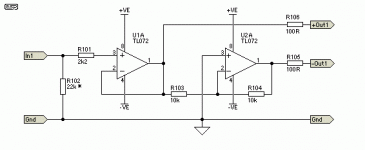
That's why I also pointed him to AN-1192. That type of circuit would work if he were starting with just the chipamp chips, but not if he already has, for example, two identical non-inverting chipamp-based power amplifier boards. I assumed he wouldn't be asking if he was starting with just the chips.
-----
I do not consider myself to be an expert at this stuff. But I think it is debatable; i.e. whether or not a transformer-based approach would necessarily have "the best" common-mode rejection (CMR) [before even getting to the debate about whether or not it would be "the best solution", overall].
If you read the section entitled "A Summary of Line Receivers", on page 463 (in Chapter Six) of Walt Jung's "OP Amp Applications Guide", which is downloadable from http://www.analog.com/library/analo...s_handbook.html , he notes that the solid-state approach has the best high-frequency CMR, in absolute terms, and better CMR versus frequency flatness, while the transformer-based approach, especially if the transformer is improved by combining it with a differential amplifier for balanced-mode post-buffering (as in Fig 6-33), has the best low-to-middle frequency CMR.
Looking at the plots of CMR for the two approaches, in Figs. 6-31 and 6-34, the instrumentation amp approach has significantly better CMR than the transformer approach, everywhere above 700 Hz or so. For example, at 10 kHz, the three-op-amp instrumentation amp of Fig 6-30 shows CMR better than -100 dB, when using AD845 opamps, while the Fig 6-34 plot of the CMR of the transformer-based circuit of Fig 6-33 shows less than -75 dB at 10 Khz. At low frequencies, however, the transformer-based circuit has much better CMR, nearly -125 dB at 100 Hz, versus only about -105 dB for the opamp-based instrumentation amp circuit of Fig 6-30. (How significant all of that might be, I don't know.)
That whole section of Chapter Six, entitled "Audio Line Level Stages", and starting on page 447, is excellent reading.
It appears, at first glance at least, that one of the "balanced line receiver" types of stages could simply be added after the unbalanced-to-balanced converter, to improve the CMR. See, for example, Figure 6-30 on page 458. And it seems like (again, at first glance, at least) the CMR could be made as good as one wanted, with the solid-state approach, just by adding additional instrumentation amp stages, at relatively low cost.
[The circuit in Figure 6-56 (Page 482) looks interesting, too, in the section entitled "Cross-Coupled Differential Line Driver", as does the circuit in Fig. 6-169 (Page 585), where the three opamps in an instrumentation amp configuration are all replaced by actual instrumentation amp chips, e.g. AD623.]
At any rate, which approach is "best", overall, depends on more than the CMR specs, unless cost, size, and weight are no object. I would certainly want to try both approaches, if cost etc were no object. In my case, I think I would try the opamp-based approach first, and then spend the $ for transformers only if that was not satisfactory.
-----
I do not consider myself to be an expert at this stuff. But I think it is debatable; i.e. whether or not a transformer-based approach would necessarily have "the best" common-mode rejection (CMR) [before even getting to the debate about whether or not it would be "the best solution", overall].
If you read the section entitled "A Summary of Line Receivers", on page 463 (in Chapter Six) of Walt Jung's "OP Amp Applications Guide", which is downloadable from http://www.analog.com/library/analo...s_handbook.html , he notes that the solid-state approach has the best high-frequency CMR, in absolute terms, and better CMR versus frequency flatness, while the transformer-based approach, especially if the transformer is improved by combining it with a differential amplifier for balanced-mode post-buffering (as in Fig 6-33), has the best low-to-middle frequency CMR.
Looking at the plots of CMR for the two approaches, in Figs. 6-31 and 6-34, the instrumentation amp approach has significantly better CMR than the transformer approach, everywhere above 700 Hz or so. For example, at 10 kHz, the three-op-amp instrumentation amp of Fig 6-30 shows CMR better than -100 dB, when using AD845 opamps, while the Fig 6-34 plot of the CMR of the transformer-based circuit of Fig 6-33 shows less than -75 dB at 10 Khz. At low frequencies, however, the transformer-based circuit has much better CMR, nearly -125 dB at 100 Hz, versus only about -105 dB for the opamp-based instrumentation amp circuit of Fig 6-30. (How significant all of that might be, I don't know.)
That whole section of Chapter Six, entitled "Audio Line Level Stages", and starting on page 447, is excellent reading.
It appears, at first glance at least, that one of the "balanced line receiver" types of stages could simply be added after the unbalanced-to-balanced converter, to improve the CMR. See, for example, Figure 6-30 on page 458. And it seems like (again, at first glance, at least) the CMR could be made as good as one wanted, with the solid-state approach, just by adding additional instrumentation amp stages, at relatively low cost.
[The circuit in Figure 6-56 (Page 482) looks interesting, too, in the section entitled "Cross-Coupled Differential Line Driver", as does the circuit in Fig. 6-169 (Page 585), where the three opamps in an instrumentation amp configuration are all replaced by actual instrumentation amp chips, e.g. AD623.]
At any rate, which approach is "best", overall, depends on more than the CMR specs, unless cost, size, and weight are no object. I would certainly want to try both approaches, if cost etc were no object. In my case, I think I would try the opamp-based approach first, and then spend the $ for transformers only if that was not satisfactory.

gootee said:Looking at the plots of CMR for the two approaches, in Figs. 6-31 and 6-34, the instrumentation amp approach has significantly better CMR than the transformer approach, everywhere above 700 Hz or so. For example, at 10 kHz, the three-op-amp instrumentation amp of Fig 6-30 shows CMR better than -100 dB, when using AD845 opamps, while the Fig 6-34 plot of the CMR of the transformer-based circuit of Fig 6-33 shows less than -75 dB at 10 Khz.
Oh yeah? Well feast your eyes on this:
An externally hosted image should be here but it was not working when we last tested it.

-94dB at 20kHz and below the limits of the AP rig from 1kHz down.
😀
se
burnedfingers said:I cannot get your link to play.
Me either. But managed to track it down.
Here you go:
http://www.analog.com/library/analogDialogue/archives/39-05/op_amp_applications_handbook.html
se
Steve Eddy said:
Oh yeah? Well feast your eyes on this:
An externally hosted image should be here but it was not working when we last tested it.
-94dB at 20kHz and below the limits of the AP rig from 1kHz down.
😀
se
Nice!
May we see the schematic?
What transformer was used?
I would assume that proper layout would effect the performance of the circuit and that the average persons results wouldn't be as good as the results published. (trying to wipe egg off face)
Given the complexity of the project I would assume it might be more than some would want to bite off. It still might be easier for some to pull a pair of transformers out of the drawer and plug them into a socket.
I would assume that proper layout would effect the performance of the circuit and that the average persons results wouldn't be as good as the results published. (trying to wipe egg off face)
Given the complexity of the project I would assume it might be more than some would want to bite off. It still might be easier for some to pull a pair of transformers out of the drawer and plug them into a socket.

SY said:Steve, you got an AP and you didn't invite me over to play? I'm... crushed.
Well, it's Christmas and I figured you'd be busy... er... oh, wait... I forgot.

se
gootee said:Nice!
May we see the schematic?
Here's the datasheet from which the CMRR plot was taken along with the test circuit used.
CineMag CMOL-2x600T2
Admittedly it's being loaded with 600 ohms but you can load it higher and still achieve outstanding results with it. I'll get in touch with Tom after the holidays and see if he can provide come CMRR plots for higher load impedances.
se
burnedfingers said:What transformer was used?
See my reply to gootee above.
I would assume that proper layout would effect the performance of the circuit and that the average persons results wouldn't be as good as the results published. (trying to wipe egg off face)
Layout would perhaps play some role here. But the bulk of the CMRR performance is due to the transformer's design and construction.
Given the complexity of the project I would assume it might be more than some would want to bite off. It still might be easier for some to pull a pair of transformers out of the drawer and plug them into a socket.
True. And the CMOL-2x600T2 isn't cheap if memory serves. I seem to recall it being close to $150.
se
And for the true CMRR freaks an optical solution might be the cure for their aches... an IL300 has only 0.5pF of coupling capacitance and measures 130dB CMRR in the datasheet (probably just the test rig resolution). To get those couplers down in distortion is another pair of boots. One guy over here has just finished a IL300-based DI-box and it apparently works quite good for a first try (rather simple circuit), <0.01% THD... and with two IL300 in push-pull one can get very low distortion at any signal level (saw an app-note showing that, somewhere sometime ago, but I can't find it anymore).
- Klaus
- Klaus
- Status
- Not open for further replies.
- Home
- Amplifiers
- Chip Amps
- Line input transformer for unbalanced to balanced conversion