

It seems like more serious players are entering chip amps field now: http://www.6moons.com/industryfeatures/gill/gill.html
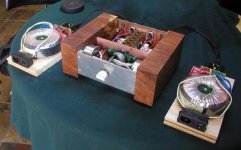
To keep up with the Joneses, I designed an integrated amp that pushes the envelope even further.
Starting with custom made toroids that have special windings and amorphous cores and dual mono design to the bridged amps output and TVC integrated volume control.
From the outside, the chassis is stylized by Levinson reference DAC and transport.
To keep up with the Joneses, I designed an integrated amp that pushes the envelope even further.
Starting with custom made toroids that have special windings and amorphous cores and dual mono design to the bridged amps output and TVC integrated volume control.
From the outside, the chassis is stylized by Levinson reference DAC and transport.
Attachments
Last edited:
From the inside, I was really influenced by Connoisseur preamps layout 😉
The front end consists of S&B102 TVC mounted on rubber dampers into Mardone Burl side panels. A stepping motor coupled to higher grade Elma switch allows remote volume control. The transformers act as phase splitters as well, allowing either balanced or single ended inuts and feeding the amps with balanced signal only.
The amps are basically Pateks in bridged configuration with a usual bypass scheme. The heatsink is made of bronze. Not a best material heatwise, but sonically better than other alloys.
The front end consists of S&B102 TVC mounted on rubber dampers into Mardone Burl side panels. A stepping motor coupled to higher grade Elma switch allows remote volume control. The transformers act as phase splitters as well, allowing either balanced or single ended inuts and feeding the amps with balanced signal only.
The amps are basically Pateks in bridged configuration with a usual bypass scheme. The heatsink is made of bronze. Not a best material heatwise, but sonically better than other alloys.
Attachments


What is interesting though, the rear panel is decoupled from the rest of the chassis with special, aircraft rubber grommets. This allows for the main heatsink assembly to be rigidly supported in one point only, with a cone, reducing unwanted chassis infuences. The other two points of support are of a semi-flexible type.
Attachments


A close up of the inside with top cover removed (as usually made of perforated aluminum for low mass).
I'm running the amp presently with 4 ohm speakers. In bridged mode it gets pretty hot and clips at louder levels. Eventually it will be used with 8ohm rated Fertins, but also as a headphone amp with AKG1000.
Regarding the TVC configuration, I opted for +6dB connection with a single primary, it sounds better this way.
What is interesting I have only 0.1uF coupling caps in my DAC and the bass is terrific, no loss at all.
Some of you might be curious how this compares to resistor based volume control I used previously. Well, not bad at all.
With that amp, the buffer after the DAC didn't work well. I much prefer direct input to TVC for more cleaner and pure sound.
The buffer worked really well with resistor based attenuator. Overall that setup had a bit more air extention, however it may also seem that it had some artifacts that were not completely natural. The current setup with TVC is very pure and natural. A bit highs shimmer is missing, but I enjoy both setups equally well (for now).
I'm running the amp presently with 4 ohm speakers. In bridged mode it gets pretty hot and clips at louder levels. Eventually it will be used with 8ohm rated Fertins, but also as a headphone amp with AKG1000.
Regarding the TVC configuration, I opted for +6dB connection with a single primary, it sounds better this way.
What is interesting I have only 0.1uF coupling caps in my DAC and the bass is terrific, no loss at all.
Some of you might be curious how this compares to resistor based volume control I used previously. Well, not bad at all.
With that amp, the buffer after the DAC didn't work well. I much prefer direct input to TVC for more cleaner and pure sound.
The buffer worked really well with resistor based attenuator. Overall that setup had a bit more air extention, however it may also seem that it had some artifacts that were not completely natural. The current setup with TVC is very pure and natural. A bit highs shimmer is missing, but I enjoy both setups equally well (for now).
Attachments


Very nice Peter. Remember, there are many types of bronze, I can't give you the details for now but my neighbour is an artists, working with bronze all day. He searched many years to find the good alloy for his work.
http://www.dirkdekeyzer.com/english.html
A bit off topic but a Gainclone of yours would fit nicely near one of those sculptures. 🙂
/Hugo
http://www.dirkdekeyzer.com/english.html
A bit off topic but a Gainclone of yours would fit nicely near one of those sculptures. 🙂
/Hugo

Very nice amp !
Hi Peter,
I have some questions
1. What power and voltage have those toroids ?
2. I noticed some bigger caps on the rectifier PCB ???
This weekend i finished Your premium kit , it works great but i want more !
It is a prototype and both pcb are mounted in such a way, that i can play with some components. Later i will put it in one nice case.
Now i am inspired and thinking about two monoblocks.
Could You post some more technical details ?
Cheers, Tomek
Hi Peter,
I have some questions
1. What power and voltage have those toroids ?
2. I noticed some bigger caps on the rectifier PCB ???
This weekend i finished Your premium kit , it works great but i want more !
An externally hosted image should be here but it was not working when we last tested it.
It is a prototype and both pcb are mounted in such a way, that i can play with some components. Later i will put it in one nice case.
Now i am inspired and thinking about two monoblocks.
Could You post some more technical details ?
Cheers, Tomek
sinski said:This weekend i finished Your premium kit , it works great but i want more !
An externally hosted image should be here but it was not working when we last tested it.
This looks like Shigaraki amp.
Toroids are 300VA, 2 x 22V AC, single primary wounded over secondaries.
There are only 100uF caps beside the chips, the ones at the rectifiers are 1000uF.
Not to create further consternation between more technically oriented guys, I will not mention what brand it is.

There are only 100uF caps beside the chips, the ones at the rectifiers are 1000uF
i tryed that with my lm4780 chipamp i was happy with the sound
lots of power. 😉 before i changed it again😀
i tryed that with my lm4780 chipamp i was happy with the sound
lots of power. 😉 before i changed it again😀


Peter, I'm curious about the wire you've used. The power and ground wires look like fairly light gauge (#22?) solid hookup wire. Is that what you normally use?
I alwyas use Cardas chassis wire, 19.5ga, for power connections. To me, that wire sounds the best in that application. The connection to binding posts is made with DH Labs hook up wire and signal wire is DH Labs solid core, 26ga silver. I'm not sure about the choices here yet.
Peter,
I foresee your integrated amp being a big hit and an amazing performer! Looks very, very promising!
The thick wood is very classy.
How would you say the bronze heatsink compares with copper or aluminum sonically? I understand there's some sort of debate over the use of bronze - I haven't read the thread yet, but I know there's some connection to the C37 theory as posited by Deiter Ennemoser. I haven't tried the bronze in anything, but the C37 lacquer was miraculous on my Lowther drivers. Big thumbs up.
Is there any problem with the switching motor interfering with the TVCs?
Best,
KT
I foresee your integrated amp being a big hit and an amazing performer! Looks very, very promising!
The thick wood is very classy.
How would you say the bronze heatsink compares with copper or aluminum sonically? I understand there's some sort of debate over the use of bronze - I haven't read the thread yet, but I know there's some connection to the C37 theory as posited by Deiter Ennemoser. I haven't tried the bronze in anything, but the C37 lacquer was miraculous on my Lowther drivers. Big thumbs up.
Is there any problem with the switching motor interfering with the TVCs?
Best,
KT
I'm not getting any interferences from the motor, the control circuit is isolated by using separate PS. While turning, the mechanism make nice clicking and definitely isn't of a quiet type.
Comparison between all those heatsinks isn't certainly an easy one. Maybe you remember that my first monoblock amp was using large copper piece acting as heatsink and structural bar. Initially, I liked the sound, but after CES, we came to conlusion that the air was somewhat missing in that amp. I was also using a clamping bar to attach the chip to the heatsink. After removing that calmp and replacing it with a regular screw things improved, but eventually we decided for aluminum heatsink as it provided more air extention, with copper it was a bit less. Those are not only my observations, but also from the people who worked with me while developing the amp.
I later built the first Patek using bronze and I found that that material provided nicely balanced sound: it was less zingy and harsh than aluminum, but didn't damp higher frequencies as much as copper. It seemed that the sound gained more refinement as well.
Brass also worked well, but somehow I didn't feel convinced about using it, I'm not sure why, maybe because of the qualities of the metal iself.
The amount of damping and air extention will depend on the mass of the heatsink and cannot be easily estimated untill tried in an actual design. It will also depend how the hetasink is attached and supported.
Also, with such small amps, I prefer some weight, so usually aluminum is out of question as it's not heavy enough. Bronze is too expensive and I can only have it in the amps for my personal use. Brass is rather hard to work with, so the only reasonable choice is copper. When used in smaller sizes, it's almost as good as bronze.
Comparison between all those heatsinks isn't certainly an easy one. Maybe you remember that my first monoblock amp was using large copper piece acting as heatsink and structural bar. Initially, I liked the sound, but after CES, we came to conlusion that the air was somewhat missing in that amp. I was also using a clamping bar to attach the chip to the heatsink. After removing that calmp and replacing it with a regular screw things improved, but eventually we decided for aluminum heatsink as it provided more air extention, with copper it was a bit less. Those are not only my observations, but also from the people who worked with me while developing the amp.
I later built the first Patek using bronze and I found that that material provided nicely balanced sound: it was less zingy and harsh than aluminum, but didn't damp higher frequencies as much as copper. It seemed that the sound gained more refinement as well.
Brass also worked well, but somehow I didn't feel convinced about using it, I'm not sure why, maybe because of the qualities of the metal iself.
The amount of damping and air extention will depend on the mass of the heatsink and cannot be easily estimated untill tried in an actual design. It will also depend how the hetasink is attached and supported.
Also, with such small amps, I prefer some weight, so usually aluminum is out of question as it's not heavy enough. Bronze is too expensive and I can only have it in the amps for my personal use. Brass is rather hard to work with, so the only reasonable choice is copper. When used in smaller sizes, it's almost as good as bronze.
Thank you for finding a use for my old cracked drumset cymbals, all bronze and now about to melted down into heatsinks(as soon as I educate myself about the probably hazardous process!) I have built the 3875 kit and am floored by the quality of sound.
Peter,
Again a creation of art! I do wonder if you have an explanation for the difference in sound when using different heatsink materials. After all it is only meant to dissipate some (not even that much) heat? Can you hypothesize why this apparent sonic difference might occur?
Again a creation of art! I do wonder if you have an explanation for the difference in sound when using different heatsink materials. After all it is only meant to dissipate some (not even that much) heat? Can you hypothesize why this apparent sonic difference might occur?
Microphonics and vibrational properties maybe?
Have you tried annealing the copper to make it softer?
Bronze is much harder than copper, and church-bell bronze is alot harder than most other bronze alloys, a friend of mine got some of it from a bell maker. Allmost impossible to work with ordinary tools. It rings like a 😀,ahem,, a bell when you tap it with a hammer , much lower damping than other alloys.
BTW, cool design
Regards,
Peter
Have you tried annealing the copper to make it softer?
Bronze is much harder than copper, and church-bell bronze is alot harder than most other bronze alloys, a friend of mine got some of it from a bell maker. Allmost impossible to work with ordinary tools. It rings like a 😀,ahem,, a bell when you tap it with a hammer
, much lower damping than other alloys. BTW, cool design
Regards,
Peter
- Home
- More Vendors...
- Audio Sector
- The most advanced GainClone amp yet