

This thread idea started here: http://www.diyaudio.com/forums/showthread.php?postid=1500369#post1500369 and is aimed to provide guidance in building a simple Gainclone amp.
While I'll be using as an example a commercial kit, there is nothing wrong with wiring the circuit point to point, without using printed board.
If commercial forum section is more appropriate for this subject, please move it there.
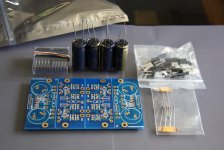
The basic kit contains printed board, 2 LM3875 chips, 8 resistors, 4 main filter capacitors and 16 diodes and is intended for dual mono application.
While I'll be using as an example a commercial kit, there is nothing wrong with wiring the circuit point to point, without using printed board.
If commercial forum section is more appropriate for this subject, please move it there.
The basic kit contains printed board, 2 LM3875 chips, 8 resistors, 4 main filter capacitors and 16 diodes and is intended for dual mono application.
Attachments

The amp basic schematic shows only 4 resistors per channel.
R1 is optional and its value can be anything between 200R and 1k (or so). I usually don't install that resistor at all, placing piece of wire in its place. Alternatively, if you need coupling capacitor to protect the amp from DC that may be produced by a source component, a small electrolytic cap can be installed here: 4.7uF or bigger.
R1 is optional and its value can be anything between 200R and 1k (or so). I usually don't install that resistor at all, placing piece of wire in its place. Alternatively, if you need coupling capacitor to protect the amp from DC that may be produced by a source component, a small electrolytic cap can be installed here: 4.7uF or bigger.
Attachments

Identifying resistor values should not be a problem, as there are 4pcs that are 22k, 2 resistors are always longer, those would be 680R and the other two are 220R. You can also use a meter to check them out: it's good idea to choose out of four 22k, two that are close in value and use them for feedback (in place of Rf)
A resistor color band conversion table is attached.
A resistor color band conversion table is attached.
Attachments


I know that... 🙂Peter Daniel said:Peranders, thanks for the input, but I prefer to do things my way.
Since we covered the content of the kit, we can start soldering.
I usually use Kester rosing core solder, 0.020 (SN63PB37). For bigger jobs 0.031 is preferrable. I also use Wonder Solder for some specific projects.
If I can recommend one tool that is really helpful, it would be solder dispenser available from percyaudio.com . It is especially useful when both hands are busy and you need to use mouth to feed the solder.
As to soldering gun, a 40W would be maximum for such project and 25W more suitable.
I have 3 Hakko stations that simplify task, but for a beginner this is not needed.
I usually use Kester rosing core solder, 0.020 (SN63PB37). For bigger jobs 0.031 is preferrable. I also use Wonder Solder for some specific projects.
If I can recommend one tool that is really helpful, it would be solder dispenser available from percyaudio.com . It is especially useful when both hands are busy and you need to use mouth to feed the solder.
As to soldering gun, a 40W would be maximum for such project and 25W more suitable.
I have 3 Hakko stations that simplify task, but for a beginner this is not needed.
Attachments


We do the chips and caps next.
The capacitors are polarized and their orientation is critical. Each electrolytic has one pin longer and this should be installed in a pad marked with + on the board. Also, the golden stripe marks the negative side and it installs opposite the +. When those caps are mounted the other way, after connecting power to the amp, they will explode.
Pin 1 and 4 on the chip are power pins and they connect to the planes in top layer. Please make sure that corresponding connection pads have enough solder in top layer as well.
That concludes the amp board. For Premium version of the kit, please check this link (currently, only blue mask boards are available, Black Gates are optional): http://www.diyaudio.com/forums/showthread.php?postid=584425#post584425
The capacitors are polarized and their orientation is critical. Each electrolytic has one pin longer and this should be installed in a pad marked with + on the board. Also, the golden stripe marks the negative side and it installs opposite the +. When those caps are mounted the other way, after connecting power to the amp, they will explode.
Pin 1 and 4 on the chip are power pins and they connect to the planes in top layer. Please make sure that corresponding connection pads have enough solder in top layer as well.
That concludes the amp board. For Premium version of the kit, please check this link (currently, only blue mask boards are available, Black Gates are optional): http://www.diyaudio.com/forums/showthread.php?postid=584425#post584425
Attachments


Peter Daniel said:The power supply section consists of 8 diodes per channel (we are discussing dual mono kit for now) and optional two small capacitors (10uF) which you may use, but they are not really required.
Peter, thanks for making it easy to follow.
1. what is the benefit of the optional caps?
2. I want to end up with 50w/ch for stereo use can u recommend an appropriate transformer from a US vendor?-web page)? I
have trouble interpreting electronic jargon I see on the figure to real world item I need to order.. I have used Partsexpress, ApexJr in past...
gychang
The optional cap are there to "manipulate" the sound. Originally, those were BG N 4.7/50 and they were supposed to add more warmth and image density to main filter Panasonic caps.
As BG are disconinued now, I supply 10uF Panasonics instead, and they can be used to sort of "improve" the sound of larger caps, as it is commonly practised by other manufacturers. I noticed that in most cases such additional caps only spoil things and it's best to test both setups and choose better sounding option.
I normally use 300VA Plitron toroids, but 200VA (for stereo) is good too. In US PartsExpress carry Avel and more affordable prices. The voltage can be between 20 - 25VAC, either dual secondaries, or centertapped.
Apexjr has ocasinally suitable transformers as well.
As BG are disconinued now, I supply 10uF Panasonics instead, and they can be used to sort of "improve" the sound of larger caps, as it is commonly practised by other manufacturers. I noticed that in most cases such additional caps only spoil things and it's best to test both setups and choose better sounding option.
I normally use 300VA Plitron toroids, but 200VA (for stereo) is good too. In US PartsExpress carry Avel and more affordable prices. The voltage can be between 20 - 25VAC, either dual secondaries, or centertapped.
Apexjr has ocasinally suitable transformers as well.

This concludes the assembly and we have two separate amp channels with separate bridge rectifiers. All is needed now is to connect 2 transformers (one per channel) as per schematic posted here: http://www.diyaudio.com/forums/attachment.php?s=&postid=1508798&stamp=1210694958 , connect the input (SG for ground, IN for signal input) and output ( OUT to positive binding post, OG to negative) and we have a working dual mono amplifier.
I will post tomorrow some instructions for stereo version, and later enclosure building ideas (any suggestions welcome here, as to which direction to go).
Pictured below, is one amp channel.
I will post tomorrow some instructions for stereo version, and later enclosure building ideas (any suggestions welcome here, as to which direction to go).
Pictured below, is one amp channel.
Attachments

which transformer?
I will be following this thread, but I get confused on the transformer to get about 55W/ch in stereo from GC.
Anyone know the website for the appropriate transformer?, need cost-effective solution for the classic GC kit from Peter.
Any of the model here work?
http://www.apexjr.com/miscellaneous.html#Toroids
or here:
http://www.partsexpress.com/webpage...+toroid&search_type=main&WebPage_ID=3&x=0&y=0
do I need one or 2 transformers. (please say 1 😀 )
gychang
I will be following this thread, but I get confused on the transformer to get about 55W/ch in stereo from GC.
Anyone know the website for the appropriate transformer?, need cost-effective solution for the classic GC kit from Peter.
Any of the model here work?
http://www.apexjr.com/miscellaneous.html#Toroids
or here:
http://www.partsexpress.com/webpage...+toroid&search_type=main&WebPage_ID=3&x=0&y=0
do I need one or 2 transformers. (please say 1 😀 )
gychang
The attached graph shows powers output vs supply voltage for different loads. Based on that, for 8 ohm speakers 2 x 22V AC transformer is recommended, and for 4 ohm speakers 2 x 18V AC transformer. In practice, I didn't find any drawbacks with using 2 x 22V AC secondaries with 4 ohms either, so that value can be a good overall choice. The amp will clip with 4ohm speakers when pushed hard, but you will soon learn not to push it on certain recordings (I had 2 or 3 such disks that I had to be careful about)😉
Attachments

- Home
- More Vendors...
- Audio Sector
- Commercial Gainclone kit- building instructions