

Hi all,
I have an old (20yrs plus) Mayware Formula 4 uni-pivot fluid damped arm I want to resurrect that is said to be a pretty nifty little number. My sample is in good condition. Either way it's a cute and attactive unit, just begging to be played with! I have the damping fluid already sourced. These babies were built in the UK and Australia - mine is the latter. I bounced this question off Allen Wright previously - he mentioned JH as the manufacturer, presumably confirming the Ausi connection.
So I need ideas for suitable cartridges please folks. Denon 304 and the 103 have been suggested. 103 difficult to obtain apparently now. I have a number of proven tweaks also for this arm. Am intending to fit to some as yet undefined self built deck - perhaps an Origin Live kit.
I have no MC i/p - so we are talking MM or hi o/p MC - but can beggers be choosers?
The spec for the arm is as follows: Can anyone translate that effective mass figure to matching cartridge compliance figure? Help me out here - hi compliance means what sort of figure? and lo comliance ...
SPECIFICATIONS (cut from UK version set-up manaual)
--------------
Effective length (stylus pivot): 224 mm
Rear overhang required: 65 mm
Height adjustment: 45 mm
Effective mass (as seen by stylus): 4.50 gram nominal+variable
Audio output lead length: 4'6" (137 cm)
Audio output lead capacitance: 112 pF (with phono plugs)
Tracking force: 0 - 3.5 grams
Pivot: inverted hardened steel pin pivoting on jewelled bearing damped by silicone fluid
Pivot friction: Less than 5 Mgm. in any plane measured at the headshell
Mayware Ltd. 15 Heather Walk, Edgware, Middlesex HA8 9TS England
Cheers
Pete
I have an old (20yrs plus) Mayware Formula 4 uni-pivot fluid damped arm I want to resurrect that is said to be a pretty nifty little number. My sample is in good condition. Either way it's a cute and attactive unit, just begging to be played with! I have the damping fluid already sourced. These babies were built in the UK and Australia - mine is the latter. I bounced this question off Allen Wright previously - he mentioned JH as the manufacturer, presumably confirming the Ausi connection.
So I need ideas for suitable cartridges please folks. Denon 304 and the 103 have been suggested. 103 difficult to obtain apparently now. I have a number of proven tweaks also for this arm. Am intending to fit to some as yet undefined self built deck - perhaps an Origin Live kit.
I have no MC i/p - so we are talking MM or hi o/p MC - but can beggers be choosers?
The spec for the arm is as follows: Can anyone translate that effective mass figure to matching cartridge compliance figure? Help me out here - hi compliance means what sort of figure? and lo comliance ...
SPECIFICATIONS (cut from UK version set-up manaual)
--------------
Effective length (stylus pivot): 224 mm
Rear overhang required: 65 mm
Height adjustment: 45 mm
Effective mass (as seen by stylus): 4.50 gram nominal+variable
Audio output lead length: 4'6" (137 cm)
Audio output lead capacitance: 112 pF (with phono plugs)
Tracking force: 0 - 3.5 grams
Pivot: inverted hardened steel pin pivoting on jewelled bearing damped by silicone fluid
Pivot friction: Less than 5 Mgm. in any plane measured at the headshell
Mayware Ltd. 15 Heather Walk, Edgware, Middlesex HA8 9TS England
Cheers
Pete
Pete,
I'm not familiar with the arm itself, but in general it's a good idea to use as compliant a cartridge as possible with a unipivot arm. That would tend to push you towards moving magnet cartridges, since most moving coils are comparatively stiff.
Perhaps some of the Grados? Over the years, Joe has produced cartridges of varying compliance, but nearly always of good sound quality. There is usually a wide range of pricing, as well, depending on how much you want to spend.
Grey
I'm not familiar with the arm itself, but in general it's a good idea to use as compliant a cartridge as possible with a unipivot arm. That would tend to push you towards moving magnet cartridges, since most moving coils are comparatively stiff.
Perhaps some of the Grados? Over the years, Joe has produced cartridges of varying compliance, but nearly always of good sound quality. There is usually a wide range of pricing, as well, depending on how much you want to spend.
Grey
Hi ya Grey - and I thought when I saw the email notification you were gonna say you'd been using one for the last 20 yrs!!! OK, Grado Prestige Gold goes on the list to audition - there's some good reviews out there.
So hi compliance is at least what sort of number - any offers? Can you explain why a unipivot needs a hi comp (i.e. floppy) stylus? I can only imagine it could be because the arm is pretty lightly built???
The JH I referred to in initial post is JH Reproducers - who made a clone of the Mayware and is what I believe I have. I'll try put some pics on my web space (hesitate to call it a site) - http://users.computerweekly.net/peted/
Any other opinions out there please....
Cheers
Pete
[Edited by peted on 07-28-2001 at 04:49 PM]
So hi compliance is at least what sort of number - any offers? Can you explain why a unipivot needs a hi comp (i.e. floppy) stylus? I can only imagine it could be because the arm is pretty lightly built???
The JH I referred to in initial post is JH Reproducers - who made a clone of the Mayware and is what I believe I have. I'll try put some pics on my web space (hesitate to call it a site) - http://users.computerweekly.net/peted/
Any other opinions out there please....
Cheers
Pete
[Edited by peted on 07-28-2001 at 04:49 PM]
Pete,
Yeah, basically it boils down to two things:
1) Low mass arms (regardless of what sort of bearings they use) always need high compliance cartridges so as to keep the cartridge/arm resonance down in the subsonic region. I don't remember ever running across a high mass unipivot arm; surely at least in part because it would cause undue wear on the bearing. (The old woman in high heel shoes exerting more psi than a truck conundrum...)
2) Some unipiviots--whether yours is one or not, I don't know--are free to roll, i.e. the pivot pin comes up underneath a cone, which leaves the arm able to bob from side to side. This changes the geometry of how the stylus contacts the groove as the record is playing. Magnepan (yes, the speaker people) used to market an arm of this sort years ago. Higher compliance cartridges are more polite about not exciting this sort of motion.
Depending on what decade we're in, the Shure cartridges may or may not be another possibility for you, as they're generally pretty compliant, too. Sometimes they review well, sometimes not. I haven't heard any model of Shure in years, so I have no opinion.
Grey
Yeah, basically it boils down to two things:
1) Low mass arms (regardless of what sort of bearings they use) always need high compliance cartridges so as to keep the cartridge/arm resonance down in the subsonic region. I don't remember ever running across a high mass unipivot arm; surely at least in part because it would cause undue wear on the bearing. (The old woman in high heel shoes exerting more psi than a truck conundrum...)
2) Some unipiviots--whether yours is one or not, I don't know--are free to roll, i.e. the pivot pin comes up underneath a cone, which leaves the arm able to bob from side to side. This changes the geometry of how the stylus contacts the groove as the record is playing. Magnepan (yes, the speaker people) used to market an arm of this sort years ago. Higher compliance cartridges are more polite about not exciting this sort of motion.
Depending on what decade we're in, the Shure cartridges may or may not be another possibility for you, as they're generally pretty compliant, too. Sometimes they review well, sometimes not. I haven't heard any model of Shure in years, so I have no opinion.
Grey
OK Grey, thanks for that. Looks like I need an arms for beginners book to get some background and a few auditions.
Oh yeah, forgot to put in the original post - the cart this arm was running with is a Sleeping Beauty (from Great american Sounds - GAS - James Bongiornio) - said by Allen Wright to be pretty much the same as a Denon 103 - compliance 5 x 10⁻⁶cm/dyne (100Hz) - that seems LOW - getting conflicting messages here - but then rules are made to be broken....
Me'be I'll shoot the question at Allen Wright again too.
Cheers
Pete
Oh yeah, forgot to put in the original post - the cart this arm was running with is a Sleeping Beauty (from Great american Sounds - GAS - James Bongiornio) - said by Allen Wright to be pretty much the same as a Denon 103 - compliance 5 x 10⁻⁶cm/dyne (100Hz) - that seems LOW - getting conflicting messages here - but then rules are made to be broken....
Me'be I'll shoot the question at Allen Wright again too.
Cheers
Pete
Pete,
It's not that the 'wrong' cartridge won't work in a given arm...it will, in just the same sense that a tube amp will drive a subwoofer, and a $6 chip amplifier will drive a $150,000 speaker system. It's more a question of relative performance. Mounting a stiff cartridge on a low mass arm will produce music, but neither will be happy. It's like a terrier worrying at a sock...the cartridge will be shaking the arm (literally), when the ideal case would be to hold the cartridge absolutely rock solid, with the cantilever being the only portion allowed to move.
Obviously, in the real world, the cartridge needs to be allowed to move so as to traverse the surface of the album. It then becomes a question of compromises. How still can you hold the cartridge relative to the groove?
Might as well throw in LOI while I'm at it...
Back twenty-five or thirty years ago there was a table called the AR. It achieved a reputation for 'sounding better' than other tables, although its specs were pretty ordinary. (Yep, the same old story.) A fellow named Ivor Tiefenbrun (I may have misspelled his last name) took a look at the AR and decided he could do the same thing, but more so. Thus was the venerable Linn Sondek born. It was a shock and revelation to those who thought that all a turntable had to do was have constant speed and low rumble. Ivor, however, wasn't just blowing smoke--he really did know why the AR sounded better (and his own Linn Sondek better still). He called it Loss Of Information Theory. The basic concept is simple. The finer details of music encoded in the grooves of a record are on the order of wavelengths of light. Sloppy bearing tolerances--well into the thousandths of inches--were allowing the sundry mechanical parts to move around sufficiently to lose the details. His solution was simple. Tighten up bearing tolerances for the main spindle bearing for the turntable (the Linn LP-12). The pivot bearings for the arm came later (the Linn Ittok arm). And all the various mechanical connections in between, including the mounting of the arm board to the sub-chassis, the arm to the arm board, etc. The result? Better everything. More, tighter bass. Solid image with more depth and width. More extended and accurate highs. The works. Other manufacturers improved things even further, but Ivor was the one who figured it all out. Thanks, Ivor. And yes, I still have my old LP-12 as a backup turntable after all these years.
Depending on how much of a masochist you are, other possible topics include: cartridge alignment, stylus pressure, overhang, tangential vs. pivotted arms, turntable suspension, mass loading of arms, arm resonance, direct vs. belt drive and VTA/SRA.
If any of that sounds interesting, let out a holler, elseways, I'm gonna take a nap...
Grey
It's not that the 'wrong' cartridge won't work in a given arm...it will, in just the same sense that a tube amp will drive a subwoofer, and a $6 chip amplifier will drive a $150,000 speaker system. It's more a question of relative performance. Mounting a stiff cartridge on a low mass arm will produce music, but neither will be happy. It's like a terrier worrying at a sock...the cartridge will be shaking the arm (literally), when the ideal case would be to hold the cartridge absolutely rock solid, with the cantilever being the only portion allowed to move.
Obviously, in the real world, the cartridge needs to be allowed to move so as to traverse the surface of the album. It then becomes a question of compromises. How still can you hold the cartridge relative to the groove?
Might as well throw in LOI while I'm at it...
Back twenty-five or thirty years ago there was a table called the AR. It achieved a reputation for 'sounding better' than other tables, although its specs were pretty ordinary. (Yep, the same old story.) A fellow named Ivor Tiefenbrun (I may have misspelled his last name) took a look at the AR and decided he could do the same thing, but more so. Thus was the venerable Linn Sondek born. It was a shock and revelation to those who thought that all a turntable had to do was have constant speed and low rumble. Ivor, however, wasn't just blowing smoke--he really did know why the AR sounded better (and his own Linn Sondek better still). He called it Loss Of Information Theory. The basic concept is simple. The finer details of music encoded in the grooves of a record are on the order of wavelengths of light. Sloppy bearing tolerances--well into the thousandths of inches--were allowing the sundry mechanical parts to move around sufficiently to lose the details. His solution was simple. Tighten up bearing tolerances for the main spindle bearing for the turntable (the Linn LP-12). The pivot bearings for the arm came later (the Linn Ittok arm). And all the various mechanical connections in between, including the mounting of the arm board to the sub-chassis, the arm to the arm board, etc. The result? Better everything. More, tighter bass. Solid image with more depth and width. More extended and accurate highs. The works. Other manufacturers improved things even further, but Ivor was the one who figured it all out. Thanks, Ivor. And yes, I still have my old LP-12 as a backup turntable after all these years.
Depending on how much of a masochist you are, other possible topics include: cartridge alignment, stylus pressure, overhang, tangential vs. pivotted arms, turntable suspension, mass loading of arms, arm resonance, direct vs. belt drive and VTA/SRA.
If any of that sounds interesting, let out a holler, elseways, I'm gonna take a nap...
Grey
Originally posted by peted
... So I need ideas for suitable cartridges please folks. Denon 304 and the 103 have been suggested. 103 difficult to obtain apparently now. I have a number of proven tweaks also for this arm. Am intending to fit to some as yet undefined self built deck - perhaps an Origin Live kit.
Hello Pete,
if you want to get MC experiences with your unipivot, you might ask John Elison on the Vinyl Asylum (he is a very helpful guy), he runs a Denon 304 (or was it 305, dunno) in an SME 3009 Series III which has an effective mass of about 3 to 4 grams. The Denon he has is definitely high-compliant and well-mated for his sort of effective mass. Quite opposite to the Denon 103 which has a compliance in close proximity to that of a screw driver. I fully agree with Grey's warnings.
However, a unipivot arm mating well with a DL 103 is not impossible, a buddy built a unipivot 12"er for his Denon and the combination seems to work fine. The arm has high rotational inertia with reference to the tonearm wand, this is why it works.
Tell me more about your self-built turntable, has the project developed already?
I do have a Mayware mkV (almost identical to IV) and use a Denon 305 and a Stanton 881S.
Both are working ok, although the marriage is not optimal: the 305 sounds better than 881 but her compliance is 'close to the limit' for the mkV.
I agree that a Grado could be the best choice (at least is my intention to try a Grado Signature as soon as my budget plan comes to the 'pick up' chapter).
Documentation for the arm is very poor, just 2 pages, also it seems that Mayware does not exist anymore, so it is very difficult to have informations on this arm. (any hint is welcome!)
BTW, in the 90 Mayware itself was trading pick-up designed for their arms, and reports are they had a damn good quality/price ratio. Maybe is possible to find a 'new old stock' somewhere.
bye
sandro
Both are working ok, although the marriage is not optimal: the 305 sounds better than 881 but her compliance is 'close to the limit' for the mkV.
I agree that a Grado could be the best choice (at least is my intention to try a Grado Signature as soon as my budget plan comes to the 'pick up' chapter).
Documentation for the arm is very poor, just 2 pages, also it seems that Mayware does not exist anymore, so it is very difficult to have informations on this arm. (any hint is welcome!)
BTW, in the 90 Mayware itself was trading pick-up designed for their arms, and reports are they had a damn good quality/price ratio. Maybe is possible to find a 'new old stock' somewhere.
bye
sandro

peted said:Hi all,
I have an old (20yrs plus) Mayware Formula 4 uni-pivot fluid damped arm I want to resurrect that is said to be a pretty nifty little number. My sample is in good condition. Either way it's a cute and attactive unit, just begging to be played with! I have the damping fluid already sourced.
In my hifi store days i sold MANY of the UK version. We put them on ARs, ERAs, Thorens TD160/165/125, Linns, Connosoiurs.
I have one of them came back to me recently (on a TD165) with almost all the set screws loose and the arm majorly ascew. I'll get to putting it all together sometime soon. (and a friend i haven't seen in years who dropped in last week is sending me another).
90% of the time these went out the door with a Grado. They don't work too well with a Denon. Most often if we were selling a higher cost MC cart we would also sell a better arm.
I'd be interested in the mods you mention. A couple standard ones are gluingthe arm where only set-screws hold things together, heatshrinking the arm tube (and losing the sliding weight for setting tracking weight).
BTW Olive Oil works fine as a damping fluid -- and is a whole lot easier to clean up.
dave
Originally posted by sandro
I do have a Mayware mkV (almost identical to IV) ...
Documentation for the arm is very poor, just 2 pages, also it seems that Mayware does not exist anymore, so it is very difficult to have informations on this arm. (any hint is welcome!)
Sandro,
i have no data about the Mayware arm, but if you post one or two pixes of this arm and tell me the data from your technical spec, i might come up with some neat hints how to set it up and to mod it to better low end performance.
After all, we will have to struggle to fill the TT forum to come with life 🙂
Hi Bernhardt,
I have no scanner &/or other digital imaging stuff (I'm an analogic residuate...), the arm is very similar to the F4 version, you can see Peted's pics. Will post the specs as soon I have time to copy the sheet.
Thank you for your offer, anyway
bye
sandro
I have no scanner &/or other digital imaging stuff (I'm an analogic residuate...), the arm is very similar to the F4 version, you can see Peted's pics. Will post the specs as soon I have time to copy the sheet.
Thank you for your offer, anyway
bye
sandro
Unipivot mod (lengthy, how and why)
Hello Sandro and all Mayware users,
looked at the pixes meanwhile and found my supicion proved.
The tonearm almost certainly has not enough rotational intertia.
A very common disease among unipivot tonearms.
Without damping, the torque exerted by the stylus on the tonearm's rotational inertia (imagine it as as rotational "effective mass") triggers rotational oscillations of low freqency, but not low enough. With damping, the arm is coupled to its pivot base, the coupling increases with the frequency going up. Of course, there is considerrable damping already at the resonant frequency and the amplitude peak of the oscillation is low. But as it is the case with all mechanical dampings, the more damping we have, the lower the Q factor and the less steep the resonance decoupling curve, the transfer function, is falling.
Which means: a low rotational inertia and considerable damping together do not make the arm near as stiff in the range of 20 to 80Hz as if the rotiational inertia would be sufficiently high and no damping is applied. Because in the latter case, the Q factor is very high, the resonant freqency is low enough (say, 1 Hz) not to disturb the audible range. In reference to the excitation, the transfer function of this oscillating system, its "output" goes from unity (below resonant freq.) to a peak way higher than unity (@ resonant frequency) and with further increasing frequency of the excitation, it drops to waaaayyy less than unity, so fast that at 20Hz (more than 4 octaves higher) it has already reached -60dB or more.
Which means in short: the arm being ultra-soft against rotational excitation at 1Hz is very stiff against them already at 20 Hz and few audio systems make it to that basement. It is superstiff at 50Hz.
Another important fact: any mass added to the arm affects the arm's effective mass in proportion to the square of it's distance to the arm's center of inertia.
As a practical result, i would carry my unipivot arm (id i 'd own one) to a mechanic wizard and tell him to mount two small rods exactly at the height of the pivot point and in rectangular orientation to the tonearm wand, or better, rectangular to the headshell's offset angle. On these rods i would mount slender, lengthy weights then to achieve a rotational resonace frequency as low as possible.
[disgressing, <tonearm resonances>]:
remember i used slender weights, the arm's effective mass in vertical direction is increased only by a tiny amount as the the slender weights have almost distance zero in reference to the arm's pivot axis of up-and-down movement. Effective mass in lateral direction is increased more and thus vertical and lateral tonearm resonant frequencies are pulled apart for which i am very grateful as a lowered lateral resonance improves tracking. Many folks believe tonearm resonance has to be between 8 and 12 Hz. I agree for the vertical resonance, a resonance too low makes the stylus jump grooves and, too high, it muddens the bass. But think a bit which triggers lateral resonance: disc excentricity (0.55 Hz at 33rpm, up to 2.5mm amplitude) and groove feed (< 1Hz, 50µm amplitude). Methinks that a lateral tonearm resonace as low as possible but above 3Hz is ok. Airborne linear tracking tonearms, particular the DIY Ladegaard arm would not work if this opinion would be dead wrong, Poul Ladegaard thought the same and proved it by his arm.
[/disgressing]
The weights should be equal and adjustable in distance to the pivot: Eeezy azimuth adjustment with high resolution is the payback 🙂 .
I would have a mechically skilled person do the modification, the arm looks soo neat 🙂
Who got lost in my description (nobody i hope 🙁 .. 🙂 ) and/or wants further proof: please track the web for Stax tonearms. Some of them have such side-weights and they work extremely well, are considered to be the best unipivots by some.
A buddy bult himself a unipivot with high rotational inertia and high effective mass too: he wanted to make his Denon DL103 track 1st class and he succeeded. He had the side-weights not at the pivot but agreed this would be better and said this would be the next development step.
Consider, the Denon has a compiance of only 5 µm/mN . A challenge for any tonearm, not only for a unipivot.
All for now, if questions arise, pester me 🙂
Hello Sandro and all Mayware users,
looked at the pixes meanwhile and found my supicion proved.
The tonearm almost certainly has not enough rotational intertia.
A very common disease among unipivot tonearms.
Without damping, the torque exerted by the stylus on the tonearm's rotational inertia (imagine it as as rotational "effective mass") triggers rotational oscillations of low freqency, but not low enough. With damping, the arm is coupled to its pivot base, the coupling increases with the frequency going up. Of course, there is considerrable damping already at the resonant frequency and the amplitude peak of the oscillation is low. But as it is the case with all mechanical dampings, the more damping we have, the lower the Q factor and the less steep the resonance decoupling curve, the transfer function, is falling.
Which means: a low rotational inertia and considerable damping together do not make the arm near as stiff in the range of 20 to 80Hz as if the rotiational inertia would be sufficiently high and no damping is applied. Because in the latter case, the Q factor is very high, the resonant freqency is low enough (say, 1 Hz) not to disturb the audible range. In reference to the excitation, the transfer function of this oscillating system, its "output" goes from unity (below resonant freq.) to a peak way higher than unity (@ resonant frequency) and with further increasing frequency of the excitation, it drops to waaaayyy less than unity, so fast that at 20Hz (more than 4 octaves higher) it has already reached -60dB or more.
Which means in short: the arm being ultra-soft against rotational excitation at 1Hz is very stiff against them already at 20 Hz and few audio systems make it to that basement. It is superstiff at 50Hz.
Another important fact: any mass added to the arm affects the arm's effective mass in proportion to the square of it's distance to the arm's center of inertia.
As a practical result, i would carry my unipivot arm (id i 'd own one) to a mechanic wizard and tell him to mount two small rods exactly at the height of the pivot point and in rectangular orientation to the tonearm wand, or better, rectangular to the headshell's offset angle. On these rods i would mount slender, lengthy weights then to achieve a rotational resonace frequency as low as possible.
[disgressing, <tonearm resonances>]:
remember i used slender weights, the arm's effective mass in vertical direction is increased only by a tiny amount as the the slender weights have almost distance zero in reference to the arm's pivot axis of up-and-down movement. Effective mass in lateral direction is increased more and thus vertical and lateral tonearm resonant frequencies are pulled apart for which i am very grateful as a lowered lateral resonance improves tracking. Many folks believe tonearm resonance has to be between 8 and 12 Hz. I agree for the vertical resonance, a resonance too low makes the stylus jump grooves and, too high, it muddens the bass. But think a bit which triggers lateral resonance: disc excentricity (0.55 Hz at 33rpm, up to 2.5mm amplitude) and groove feed (< 1Hz, 50µm amplitude). Methinks that a lateral tonearm resonace as low as possible but above 3Hz is ok. Airborne linear tracking tonearms, particular the DIY Ladegaard arm would not work if this opinion would be dead wrong, Poul Ladegaard thought the same and proved it by his arm.
[/disgressing]
The weights should be equal and adjustable in distance to the pivot: Eeezy azimuth adjustment with high resolution is the payback 🙂 .
I would have a mechically skilled person do the modification, the arm looks soo neat 🙂
Who got lost in my description (nobody i hope 🙁 .. 🙂 ) and/or wants further proof: please track the web for Stax tonearms. Some of them have such side-weights and they work extremely well, are considered to be the best unipivots by some.
A buddy bult himself a unipivot with high rotational inertia and high effective mass too: he wanted to make his Denon DL103 track 1st class and he succeeded. He had the side-weights not at the pivot but agreed this would be better and said this would be the next development step.
Consider, the Denon has a compiance of only 5 µm/mN . A challenge for any tonearm, not only for a unipivot.
All for now, if questions arise, pester me 🙂
Hi Bernard,
many thanks for the info here - as thread starter I must apologise for not monitoring it more - lack of time I'm afraid. No - the science is good - keep it coming...
I have updated my site at http://users.computerweekly.net/peted/arm.htm as follows:
1) Two new pics of my own arm - 95% sure this is a JH Labs Reproducers version of the Mayware (hopefully the new pics will clinch it.)
2) Details of some tweaks I have obtained. I am not in contact with or know who the arthor was, nor have I tried these tweaks myself - take them for what they are worth, but they appear to be aimed at stiffening and damping.
Also there is an orginal Mayware manual for the Mk4.
My arm is very light - the headshell appears very flimsy - common sense might suggest it's all too flimsy - but then perhaps not at audio freq - and we all know the appicane of science (even common sense!) is often dangerous in this game...
Hope this helps
Pete
many thanks for the info here - as thread starter I must apologise for not monitoring it more - lack of time I'm afraid. No - the science is good - keep it coming...
I have updated my site at http://users.computerweekly.net/peted/arm.htm as follows:
1) Two new pics of my own arm - 95% sure this is a JH Labs Reproducers version of the Mayware (hopefully the new pics will clinch it.)
2) Details of some tweaks I have obtained. I am not in contact with or know who the arthor was, nor have I tried these tweaks myself - take them for what they are worth, but they appear to be aimed at stiffening and damping.
Also there is an orginal Mayware manual for the Mk4.
My arm is very light - the headshell appears very flimsy - common sense might suggest it's all too flimsy - but then perhaps not at audio freq - and we all know the appicane of science (even common sense!) is often dangerous in this game...
Hope this helps
Pete
I used to own one one of those, although I could swear it was manufactured in Japan. FWIW I used a Shure V15 type IV...very high compliance, with good results. But I never liked the way it rocked from side to side as it encountered warps.
Thanxalot for the +FB 🙂Originally posted by peted
many thanks for the info here - as thread starter I must apologise for not monitoring it more - lack of time I'm afraid. No - the science is good - keep it coming...
Went thru your site. The author of your mods obvioulsy had tried them all out and knows what he is talking about. I would have recommended just the same from experiences with other tonearms. I'd suggest you consider it as you Mayware mod bible ald follow thru all theI have updated my site at
http://users.computerweekly.net/peted/arm.htm as follows:
1) Two new pics of my own arm - 95% sure this is a JH Labs Reproducers version of the Mayware (hopefully the new pics will clinch it.)
2) Details of some tweaks I have obtained. I am not in contact with or know who the arthor was, nor have I tried these tweaks myself - take them for what they are worth, but they appear to be aimed at stiffening and damping.
Also there is an orginal Mayware manual for the Mk4.
mods, any single of them. Maybe you add my rotational inertia increasing mod tothis list and together with that, apply as few silicone oil damping as you can live with.
Use single strand silver wire. Try the 75µm wire from
http://www.a-msystems.com/physiology/products/wire/coatedsilverwire.asp. So will i, currently i use 100µm enamelled copper wire in my SME V.
Have to agree. Headshell is flimsy. I have a headshell mod but hesitate to post it as it is a permanent mod like the cartridge glueing but may work out different with different arms. I would assist with advice (offlist) but you have to do it at your own risk.My arm is very light - the headshell appears very flimsy - common sense might suggest it's all too flimsy - but then perhaps not at audio freq - and we all know the appicane of science (even common sense!) is often dangerous in this game...
Consider, the original Decca unipivot arm used a thin and soft piece of bent sheet metal as headshell -- and sings like hell with it. So flimsy headshells can work (must be errors compensating errors : ) ). But as your mod author recommends heavy headshell damping, i would presume that building a new headshell around the Mayware's original one (using 0.5mm thick FP4 PCB material spaced by µ-balloon-filled epoxy) has nothing but advantages.
Email me if you are bold enough to try it 🙂
peted said:95% sure this is a JH Labs Reproducers version of the Mayware
2) Details of some tweaks I have obtained. I am not in contact with or know who the arthor was, nor have I tried these tweaks myself - take them for what they are worth, but they appear to be aimed at stiffening and damping.
100% sure. I have attached a picture of my sad mayware F4.
I have tried most of the tweaks mentioned (my earlier post covered off what is considered standard mods) and they do work, enhancing rigidity & reducing sources of resonance.
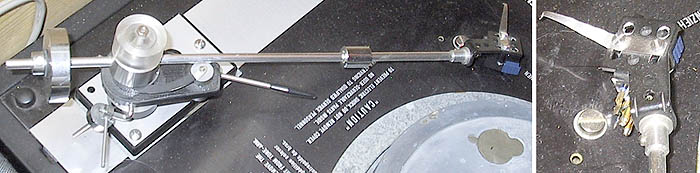
dave
Ah, good old JH. Back in the late 60's to late 70s JH manufactured the cheapest turntable available to Australian Hi Fi owners. They practically had a monopoly on locally manufactured turntables, and the JH was dirt cheap at around $40.
$40 got you a wooden base about eighteen inches by fifteen inches by five inches, with absolutely no suspension. The belt drive turntable was screwed directly to this wooden base. The turntable was powered by a small clock motor with a round belt about 1/8" in diameter, with a nasty join in it. The rotation of the turntable was easily stopped by simply touching it with one finger.
Like so many Australians buying a Hi-Fi system at the time, I started out with one of these turntables. Back then I was an apprentice electrician, and my first hi-fi system consisted of a JH turntable, a Sansui amplifier and a pair of headphones. I couldn't afford speakers until about six months later. I bought the turntable second hand and it had a tonearm already mounted on it.
JH had this single product to their name; a bare minimum turntable at the bottom of the belt drive heap.
Around 1975 JH introduced a second product; the JH unipivot arm. It too sold for $40, and unlike its stable mate, the hi-fi press raved about this simple but effective tonearm. I bought one, and added it to my trusty JH turntable.
The tonearm was terrific, and found itself mounted on a couple of different turntables over the next few years, until that fateful day it was smashed when I moved house in 1980.
By that time JH industries was no more. Some time in the mid 70s they stopped producing the turntable, and a little after that, the tonearm disappeared. JH faded away and have never been heard of since.
I can confirm from your pictures that the tonearm is identical to the one I owned.
$40 got you a wooden base about eighteen inches by fifteen inches by five inches, with absolutely no suspension. The belt drive turntable was screwed directly to this wooden base. The turntable was powered by a small clock motor with a round belt about 1/8" in diameter, with a nasty join in it. The rotation of the turntable was easily stopped by simply touching it with one finger.
Like so many Australians buying a Hi-Fi system at the time, I started out with one of these turntables. Back then I was an apprentice electrician, and my first hi-fi system consisted of a JH turntable, a Sansui amplifier and a pair of headphones. I couldn't afford speakers until about six months later. I bought the turntable second hand and it had a tonearm already mounted on it.
JH had this single product to their name; a bare minimum turntable at the bottom of the belt drive heap.
Around 1975 JH introduced a second product; the JH unipivot arm. It too sold for $40, and unlike its stable mate, the hi-fi press raved about this simple but effective tonearm. I bought one, and added it to my trusty JH turntable.
The tonearm was terrific, and found itself mounted on a couple of different turntables over the next few years, until that fateful day it was smashed when I moved house in 1980.
By that time JH industries was no more. Some time in the mid 70s they stopped producing the turntable, and a little after that, the tonearm disappeared. JH faded away and have never been heard of since.
I can confirm from your pictures that the tonearm is identical to the one I owned.

<i><font color=#800000>Who got lost in my description (nobody i hope .. ) and/or wants further proof: please track the web for Stax tonearms. Some of them have such side- weights and they work extremely well, are considered to be the best unipivots by some.</font> </i>
Like this from the "<a href="http://isweb4.infoseek.co.jp/art/exp4/">STAX Unofficial Page</a>"
<a href="http://www.hoops.ne.jp/~asd123asd/ua90.htm"><img src="http://www.hoops.ne.jp/~asd123asd/ua90n-2.jpg" ></a>
For a moment I thought you ment something like the <a href="http://patft.uspto.gov/netacgi/nph-Parser?Sect1=PTO1&Sect2=HITOFF&d=PALL&p=1&u=/netahtml/srchnum.htm&r=1&f=G&l=50&s1='4352178'.WKU.&OS=PN/4352178&RS=PN/4352178">Cartridge equalizer US Patent 4,352,178</a> see attached pic below.
<hr width="95%" align=center>
With regard to peted/images/arm_mods.htm
<i>Movtite?</i>, I think this should read <a href="http://www.efi.org/products/weather/mortite.html">MORTITE</a> Rope Caulk?
Regards
James
Like this from the "<a href="http://isweb4.infoseek.co.jp/art/exp4/">STAX Unofficial Page</a>"
<a href="http://www.hoops.ne.jp/~asd123asd/ua90.htm"><img src="http://www.hoops.ne.jp/~asd123asd/ua90n-2.jpg" ></a>
For a moment I thought you ment something like the <a href="http://patft.uspto.gov/netacgi/nph-Parser?Sect1=PTO1&Sect2=HITOFF&d=PALL&p=1&u=/netahtml/srchnum.htm&r=1&f=G&l=50&s1='4352178'.WKU.&OS=PN/4352178&RS=PN/4352178">Cartridge equalizer US Patent 4,352,178</a> see attached pic below.
<hr width="95%" align=center>
With regard to peted/images/arm_mods.htm
<i>Movtite?</i>, I think this should read <a href="http://www.efi.org/products/weather/mortite.html">MORTITE</a> Rope Caulk?
Regards
James
Attachments

- Home
- Source & Line
- Analogue Source
- Mayware Formula 4 Uni-Pivot arm