

Rumble is something that has always irritated me and I have always been dissatisfied with the standard cascaded high pass filter type designs.
One of my many hobbies is restoration, mostly dead mono 78s, but sometimes the odd LP. If the disc is even slightly warped, then the rumble immediately shows up on the waveform and it seems impossible to reduce it to a good level without affecting the audio. Even with a 160dB/Decade filter at 20Hz or so, I can still see the bass drivers in my RX6's quivering, this is (to me) intolerable 😡. The fluttery effect on the stereo image that it causes is horrible 🙁.
However, when using mixing the stereo track down to mono, this dissapears almost completely (all thats left is some very low frequency noise <8Hz), along with the low frequency 'road noise' sound. 95% of this crap seems to lie in the stereo separation (vertical plane of the stylus' movement).
By experimenting with the filters and effects in Audacity on some quick transfers I have found that:
Firstly, virtually no discs have any real stereo separation below about 200Hz or so at most, this means that I can lose the separation at, say, 150Hz without any change to the original audio. By splitting the channels at this frequency with 40dB/Decade filters and then mixing the two low frequency tracks together the rumble can be almost completely eliminated with far greater effectivity than just using a high pass filter. It will cancel rumble of far far higher frequencies than just a high pass filter ever could. No more 'road noise' 😀!
Secondly, after this has been applied, the remaining rumble is of very low frequency, and a simple 40dB/decade filter at 12Hz does the job wonderfully. After this has been applied, the rumble becomes invisible on the waveform (and more importantly inaudible), as opposed to simply having the subsonic elements attenuated when using a high pass filter. This filter really works wonders at reducing low frequency surface noise well above 100Hz.
I have incorporated my findings into a circuit that will sit between my phono preamp and control amp (see attached) although a little more complicated than a steep subsonic filter, the extra complexity is well worth it. The circuit applies an 60dB/Decade filter at 12Hz, and collapses the stereo image below 160Hz. When using these filters on Audacity the rumble is reduced by about 24dB at 20Hz.
I'd be interested to hear peoples ideas on this concept, so tell me what you think 🙂. I'm still experimenting so will keep this thread posted with my results.
One of my many hobbies is restoration, mostly dead mono 78s, but sometimes the odd LP. If the disc is even slightly warped, then the rumble immediately shows up on the waveform and it seems impossible to reduce it to a good level without affecting the audio. Even with a 160dB/Decade filter at 20Hz or so, I can still see the bass drivers in my RX6's quivering, this is (to me) intolerable 😡. The fluttery effect on the stereo image that it causes is horrible 🙁.
However, when using mixing the stereo track down to mono, this dissapears almost completely (all thats left is some very low frequency noise <8Hz), along with the low frequency 'road noise' sound. 95% of this crap seems to lie in the stereo separation (vertical plane of the stylus' movement).
By experimenting with the filters and effects in Audacity on some quick transfers I have found that:
Firstly, virtually no discs have any real stereo separation below about 200Hz or so at most, this means that I can lose the separation at, say, 150Hz without any change to the original audio. By splitting the channels at this frequency with 40dB/Decade filters and then mixing the two low frequency tracks together the rumble can be almost completely eliminated with far greater effectivity than just using a high pass filter. It will cancel rumble of far far higher frequencies than just a high pass filter ever could. No more 'road noise' 😀!
Secondly, after this has been applied, the remaining rumble is of very low frequency, and a simple 40dB/decade filter at 12Hz does the job wonderfully. After this has been applied, the rumble becomes invisible on the waveform (and more importantly inaudible), as opposed to simply having the subsonic elements attenuated when using a high pass filter. This filter really works wonders at reducing low frequency surface noise well above 100Hz.
I have incorporated my findings into a circuit that will sit between my phono preamp and control amp (see attached) although a little more complicated than a steep subsonic filter, the extra complexity is well worth it. The circuit applies an 60dB/Decade filter at 12Hz, and collapses the stereo image below 160Hz. When using these filters on Audacity the rumble is reduced by about 24dB at 20Hz.
I'd be interested to hear peoples ideas on this concept, so tell me what you think 🙂. I'm still experimenting so will keep this thread posted with my results.
Attachments
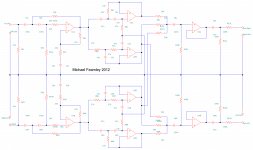

It's a very impressive circuit but I'm surprised you were driven to research it ... as I have never experienced rumble with my LP12. Maybe (for better musical enjoyment) you need to get a different TT as the problem I see with this device (sitting as it does between phono stage and line stage) ... is that it inevitably must be degrading the signal, compared to if it wasn't there? (IE. yes, it fixes your rumble issue but it does that at a cost. 😱 )
Regards,
Andy
Regards,
Andy

I think the answer here is in the quote
'One of my many hobbies is restoration, mostly dead mono 78s, but sometimes the odd LP.'
Turntable rumble is not the issue, I think, more the LF noise inherent in the recordings and the physical limitations of the discs themselves.
In the studio world, the idea of 'mono-ising' low frequencies is very common and the technique you describe is one that many people (myself included) use as a matter of course when digitising very noisy recordings. It is normally done using processing plugins in a DAW. Your attempt to implement it in hardware is admirable.
And I am sure you can take it out of circuit when you don't need it. 🙂
Regards,
blakkvelvet
'One of my many hobbies is restoration, mostly dead mono 78s, but sometimes the odd LP.'
Turntable rumble is not the issue, I think, more the LF noise inherent in the recordings and the physical limitations of the discs themselves.
In the studio world, the idea of 'mono-ising' low frequencies is very common and the technique you describe is one that many people (myself included) use as a matter of course when digitising very noisy recordings. It is normally done using processing plugins in a DAW. Your attempt to implement it in hardware is admirable.
And I am sure you can take it out of circuit when you don't need it. 🙂
Regards,
blakkvelvet
How's your tone arm resonance? Causing any problems?
If you're asking me ... I have absolutely no problems with tone-arm resonance. 🙂
Regards,
Andy
I didn't know that this was done so much in restoration, although with some of the CDs out there I have very little faith in analogue restoration practice at the moment 🙁 (CEDAR being overused), although I've been doing it in the digital domain for a while, I would like to put it in a box and use it when playing back some LPs through my hifi.
I don't think I have any problem with tonearm resonance as the LF noise doesn't seem to peak anywhere on an FFT on most recordings, it seems rather flat (within it's limits) to me. The turntable setup I have is a Project Debut 3 with a Shure M97XE and is meticulously, almost to the point of becoming obsessively, adjusted for optimum performance.
I only have rumble problems with some discs, mostly early stereo LPs, but I can't see any reason why putting a well constructed version of this circuit in the signal chain would hurt anything, OPA4134's have a distortion of something like 0.000008% or so at unity gain (look it up if you don't believe me) and are very low noise, so I don't think that theres any chance of degradation as any distortion/noise introduced would be immeasurable when connected to even the very best phono preamps 😀. I think it's well worth any LF inter modulation that any rumble whatsoever will inevitably cause in the speakers. The rest of my setup goes all the way down to 2Hz, so having a cutoff of 12Hz is not a bad thing (especially as the response of the cartridge only goes down to 20Hz and then rolls off increasingly steeply after that). Seeing as the process is transparent (no LPs have stereo separation at below 200Hz anyway, and I can't hear below 12Hz, and its extremely flat till then), I see no problem in having this circuit permanently between my preamp and control amp. If you don't agree with me then you can ABX test it (with a very flat disc, of course 🙂).
I don't think I have any problem with tonearm resonance as the LF noise doesn't seem to peak anywhere on an FFT on most recordings, it seems rather flat (within it's limits) to me. The turntable setup I have is a Project Debut 3 with a Shure M97XE and is meticulously, almost to the point of becoming obsessively, adjusted for optimum performance.
I only have rumble problems with some discs, mostly early stereo LPs, but I can't see any reason why putting a well constructed version of this circuit in the signal chain would hurt anything, OPA4134's have a distortion of something like 0.000008% or so at unity gain (look it up if you don't believe me) and are very low noise, so I don't think that theres any chance of degradation as any distortion/noise introduced would be immeasurable when connected to even the very best phono preamps 😀. I think it's well worth any LF inter modulation that any rumble whatsoever will inevitably cause in the speakers. The rest of my setup goes all the way down to 2Hz, so having a cutoff of 12Hz is not a bad thing (especially as the response of the cartridge only goes down to 20Hz and then rolls off increasingly steeply after that). Seeing as the process is transparent (no LPs have stereo separation at below 200Hz anyway, and I can't hear below 12Hz, and its extremely flat till then), I see no problem in having this circuit permanently between my preamp and control amp. If you don't agree with me then you can ABX test it (with a very flat disc, of course 🙂).

I recommend a simpler topology: convert X-Y to M-S, HP filter S (use Bessel filter for minimum group delay), then convert back to X-Y.
Last edited:
The idea of 'mono-ising' LF resurfaces from time to time. The record itself will have had this treatment, so if done carefully most of what you are throwing away will be noise rather than signal.
A simpler version can be achieved by adding a cross-channel resistor at the right point in the RIAA network in a phono preamp. This only gives 6dB/octave LF mixing, but it might be enough for warped LPs.
A simpler version can be achieved by adding a cross-channel resistor at the right point in the RIAA network in a phono preamp. This only gives 6dB/octave LF mixing, but it might be enough for warped LPs.
The turntable setup I have is a Project Debut 3 with a Shure M97XE and is meticulously, almost to the point of becoming obsessively, adjusted for optimum performance.
With respect, while you may well have "obsessively adjusted ït for optimum performance", a Project Debut 3 with a Shure M97XE is at the low end of the vinyl delivery scale.
I only have rumble problems with some discs, mostly early stereo LPs, but I can't see any reason why putting a well constructed version of this circuit in the signal chain would hurt anything, OPA4134's have a distortion of something like 0.000008% or so at unity gain (look it up if you don't believe me) and are very low noise, so I don't think that there's any chance of degradation as any distortion/noise introduced would be immeasurable when connected to even the very best phono preamps 😀.
IMO, you are confusing a distortion rating with "degrading the vinyl signal".
Let me give you an example: at one stage, I decided it would be a nice idea to have a "mono" switch on my phono stage. This phono stage is not a bad piece of kit - it's seen off an EAR 834P, for instance. 🙂
So I installed the phono switch - simply connecting the 2 input "hots" together (possibly with a series res on each side - I can't remember) ... and it significantly reduced the width of the sound stage - this is when the switch was "off" (ie. the switch was the problem - which has zero distortion! 😀). This is not something that would be picked up on any oscilloscope - or, indeed, any piece of measuring equipment! 😱
Regards,
Andy
Last edited:
I have just estimated the stray capacitance you might need to upset stereo width. I was surprised at the result.
Assuming an output impedance of 1k, and cross-talk of -60dB at 20kHz, 8pF would do it. Some switches could have capacitance in that region. Reducing the output impedance would solve the problem. -60dB crosstalk ought to be measurable, although perhaps not with just an oscilloscope. Of course, a pickup cartridge might only have -40dB separation anyway.
So be careful how you introduce a mono switch. It can be done, but like everything else in audio electronics it has to be done properly which probably means doing some sums first.
Assuming an output impedance of 1k, and cross-talk of -60dB at 20kHz, 8pF would do it. Some switches could have capacitance in that region. Reducing the output impedance would solve the problem. -60dB crosstalk ought to be measurable, although perhaps not with just an oscilloscope. Of course, a pickup cartridge might only have -40dB separation anyway.
So be careful how you introduce a mono switch. It can be done, but like everything else in audio electronics it has to be done properly which probably means doing some sums first.
So be careful how you introduce a mono switch. It can be done, but like everything else in audio electronics it has to be done properly which probably means doing some sums first.
Correct, DF96 - my point was simply to illustrate that at these low signal levels, anything superfluous will probably degrade the signal (compared to it not being there) ... so this "super rumble filter" will undoubtedly do so. And having to decide whether you need to plug it in, or out, of your signal chain, record by record, will spoil the enjoyment of listening. 🙂
So, yes - great for a specific task - digitising old LPs ... but not otherwise.
Regards,
Andy
Andyr - I challenge you to build and ABX test the circuit on your setup if you believe it will produce noticeable artifacts! Unless you believe that the ABX switchbox will generate some horrific 'multi phasic frequency inhibited shifts'...
Consider the following facts:
Don't forget, that there is NO capacitive coupling between channels (and using a mono switch does NOT hurt channel rejection unless you put a cap across it). Measurements can pick up EVERYTHING, to say otherwise is simply operating outside the realms of reality 😉. This circuit is designed to work at line level, not at the ultra low MM/MC levels where loading really matters.
This circuit does nothing to degrade the signal and theres no point in trying to save the separation in the bass that isn't there on any vinyl releases. Also good quality digital audio is far superior vinyl 😛.
Consider the following facts:
- Even the very best phono cartridges have 30dB of cross channel rejection.
- Your speakers and room will not have more than 20dB.
- 60dB of cross channel leakage will not be perceptible at 20KHz, or indeed at any frequency, if you don't believe me then I can send you a few couple of samples (one without the leakage and one with it)! You probably heard the effects of the series resistors causing changes to the cartridge loading, by putting a series resistance in front of the capacitive load in the preamp (if you actually heard anything).
Don't forget, that there is NO capacitive coupling between channels (and using a mono switch does NOT hurt channel rejection unless you put a cap across it). Measurements can pick up EVERYTHING, to say otherwise is simply operating outside the realms of reality 😉. This circuit is designed to work at line level, not at the ultra low MM/MC levels where loading really matters.
This circuit does nothing to degrade the signal and theres no point in trying to save the separation in the bass that isn't there on any vinyl releases. Also good quality digital audio is far superior vinyl 😛.
I wasn't 'playing maths games', merely doing what all engineers do: estimating whether a claim is plausible. 1k is a reasonable estimate of source impedance. -60dB was probably too low, because of other issues (one of which I mentioned).
I have no idea what the interchannel capacitance is in a cartridge, but simple internal screening could ensure that it stays low. My conclusion that a claim is plausible does not necessarily mean that I accept it; it merely means that I am prepared to consider it.
I have no idea what the interchannel capacitance is in a cartridge, but simple internal screening could ensure that it stays low. My conclusion that a claim is plausible does not necessarily mean that I accept it; it merely means that I am prepared to consider it.
Sorry DF96 if I seemed a little sharp there, I was merely a little exasperated with andyr's somewhat pseudoscientific approach to this concept 🙁. What I really meant was that the effects of stray switch capacitance can (generally) be considered irrelevant because with a decent toggle switch in direct contact with the chassis, the capacitance is less than negligible. I was simply comparing using the same methods, the channel rejection of my circuit in contrast to the set of conditions that you described. 🙂

Thanks, I was just wondering because I've had problems with that in the past. It really made the woofers jiggle! But it you aren't seeing a peak on the FTT, it's likely not the problem.I don't think I have any problem with tonearm resonance as the LF noise doesn't seem to peak anywhere on an FFT on most recordings, it seems rather flat (within it's limits) to me.
And yet that cart is well liked in blind tests. Go figure. 😉..a Project Debut 3 with a Shure M97XE is at the low end of the vinyl delivery scale.
Sorry DF96 if I seemed a little sharp there, I was merely a little exasperated with andyr's somewhat pseudoscientific approach to this concept
I can't see how you can call my approach "pseudoscientific" ... as all I said was that, based on an experiment I had done (putting a mono switch at the output of my phono stage - which had a deleterious effect on the signal), I thought it was likely your rumble filter would degrade the sound, compared to it not being there.
But in the context of your original post - which was that you built the filter to assist you when you digitise old recordings - it undoubtedly does an excellent job ... and the signal "quality" on these old recordings is probably not to a level of quality such that you can hear the degradation caused by the circuit. But I wouldn't use the filter for good LPs. 🙂
Don't get me wrong - I am in awe of your expertise in designing that circuit ... I just wouldn't keep it in place for all your LP listening.
Regards,
Andy
Andy, I already use a software implementation when doing restoration. What I plan to use this circuit for is live playback for all discs as the resultant intermodulation that even a little rumble causes in the loudspeakers and headphones will be far outweighed by any 'degredation' caused by the circuit, using even the very best setups. This intermodulation is highly undesirable and, even with very small amounts of rumble, causes the stereo image to 'wobble' (in my experience with several setups), anything that can reduce it is a good thing 😀. I stated this in my original post.
I just can't see any valid reason to not use this circuit in the signal chain. I would reconsider this if it caused any deterioration to the audio present in the disc, but with my experiments in audacity, subtracting the output of the process from the input show that all that is missing is just rumble and distortion - all undesirables. None of what is removed has any musical relevance to the content that was originally cut to the disc.
Further research into mastering practice confirms that mastering engineers deliberately removed the separation at lower frequencies for vinyl mastering to limit vertical excursion, they also use subsonic filters when cutting (and a digital delay too after about 1978 to optimise groove pitch between loud and soft passages). This makes my filter circuit a completely transparent and beneficial process, all that is rejected is substantial noise, seeing as surface noise is mainly composed of lower frequencies, my filter brings down this surface noise at these frequencies admirably too.
You are correct that saying that everything causes some deterioration to the audio signal, but the effects of this circuit are well, well below any of the effects that the rest of even the very best hifi will cause. I cannot overemphasise the lack of change to the original audio recorded to the disc that this filter will cause 🙂.
I referred to your approach as pseudoscientific for a couple of reasons, the main being that the series resistors that you used caused an adverse effect to the cartridge loading (I am 100% certain that this was the cause of the problem), if it was a switch on it's own and you blind tested it, then I would take your findings seriously, but there were too many psychological/other factors present for your experiment to be valid. All the experiments I have performed while tweaking my rolloff values have been performed double blind for best results.
If you know any technical reason why my circuit will cause deterioration to the sound quality, then please let me know! No hard feelings, though eh? 🙂
I just can't see any valid reason to not use this circuit in the signal chain. I would reconsider this if it caused any deterioration to the audio present in the disc, but with my experiments in audacity, subtracting the output of the process from the input show that all that is missing is just rumble and distortion - all undesirables. None of what is removed has any musical relevance to the content that was originally cut to the disc.
Further research into mastering practice confirms that mastering engineers deliberately removed the separation at lower frequencies for vinyl mastering to limit vertical excursion, they also use subsonic filters when cutting (and a digital delay too after about 1978 to optimise groove pitch between loud and soft passages). This makes my filter circuit a completely transparent and beneficial process, all that is rejected is substantial noise, seeing as surface noise is mainly composed of lower frequencies, my filter brings down this surface noise at these frequencies admirably too.
You are correct that saying that everything causes some deterioration to the audio signal, but the effects of this circuit are well, well below any of the effects that the rest of even the very best hifi will cause. I cannot overemphasise the lack of change to the original audio recorded to the disc that this filter will cause 🙂.
I referred to your approach as pseudoscientific for a couple of reasons, the main being that the series resistors that you used caused an adverse effect to the cartridge loading (I am 100% certain that this was the cause of the problem), if it was a switch on it's own and you blind tested it, then I would take your findings seriously, but there were too many psychological/other factors present for your experiment to be valid. All the experiments I have performed while tweaking my rolloff values have been performed double blind for best results.
If you know any technical reason why my circuit will cause deterioration to the sound quality, then please let me know! No hard feelings, though eh? 🙂
Also, with the 'everything causes deterioration' approach, one might as well argue that the RIAA curve should be abolished  . Having restored acoustic recordings in the past, I can tell you that you definitely don't want to go down this route! This circuit works on similar principles!
. Having restored acoustic recordings in the past, I can tell you that you definitely don't want to go down this route! This circuit works on similar principles!Hi,
IMO what you want is a Cauer or elliptical filter, its far simpler
if you want something over a simple 12dB/18dB highpass filter.
3rd order high pass Cauer can be done around a single op-amp.
Basic 6dB high pass followed by a 2nd order notch filter, it can
emulate far higher order filters in the initial stopband depending
on the notch Q, and you match the notch Q to the problem.
Its far more elegant than brute force high order highpass,
especially when the high order high pass function is not
needed below the problem area you are addressing.
sreten.
IMO what you want is a Cauer or elliptical filter, its far simpler
if you want something over a simple 12dB/18dB highpass filter.
3rd order high pass Cauer can be done around a single op-amp.
Basic 6dB high pass followed by a 2nd order notch filter, it can
emulate far higher order filters in the initial stopband depending
on the notch Q, and you match the notch Q to the problem.
Its far more elegant than brute force high order highpass,
especially when the high order high pass function is not
needed below the problem area you are addressing.
sreten.
- Home
- Source & Line
- Analogue Source
- The ultimate rumble filter - far more effective than just a high pass filter!