

I have a doubt, I measured with a precision scale the weight of my combo cart/tonearm so I adjusted as cart specs but the weight measured by the scale isn't the same than the tonearm is marked as weight, my tonearm specs says than tracking force must be the same like the cart/tonearm weight, so my question is: wich tracking force I need to set?
1. The same TF like the tonearm read & don't it's the same as the precision scale.
2. The real measured weight by the precision scale
The enclosed pics show the TF 2.5gr as the precision scale measure but the tonearm is measuring 0.6gr😕
1. The same TF like the tonearm read & don't it's the same as the precision scale.
2. The real measured weight by the precision scale
The enclosed pics show the TF 2.5gr as the precision scale measure but the tonearm is measuring 0.6gr😕
Attachments
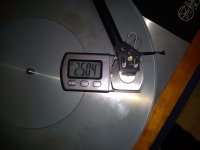
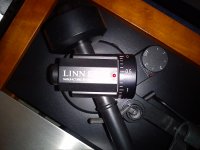
The balance is reading incorrectly - it could be the balance needs calibration or else the magnet in the cart is throwing it off. Is it an MC cart?
The balance is calibrated before measuring, it's a Denon DL103R cart, the tonearm it's done correctly the setup: when 0 gr marked the tonearm don't go down or up it's horizontal with chassis TT

The best you can do is this:
Zero the tracking force with the force adjustment of your arm and check that there is no down-up torgue when the arm is out from it's rest position.
The arm should remain horizontal.
Note the marking on the tracking force dial.
Then place the needle on your precision scale. The scale should read almost zero. If it reads more than 0.5 gr then it is the pull of the cartridge magnet.
In this case, note the scale's reading.
Now you have the first two numbers.
1. The arm's tracking force dial (call it "arm zero")
2. The precision's scale reading (call it "prec zero")
What comes out from ["prec zero"] – ["arm zero"] is the offset of your precision scale (whatever causes it) at zero tracking force. Call it “zero error”.
Now apply the recommended tracking force (say 2 gr) and note the marking on the tracking force dial.
Place the needle on your precision scale. Note the new reading.
Now you have the second set of numbers
3. The arm's tracking force dial (call it "arm read")
4. The precision's scale reading (call it "prec read")
The operation ["prec read"] – ["arm read”] should give a number close to “zero error”. If not, adjust slightly the tracking force and take readings 3. and 4. again in order to achieve this.
Regards
George
PS. I trust that your platter is made from aluminum.
Zero the tracking force with the force adjustment of your arm and check that there is no down-up torgue when the arm is out from it's rest position.
The arm should remain horizontal.
Note the marking on the tracking force dial.
Then place the needle on your precision scale. The scale should read almost zero. If it reads more than 0.5 gr then it is the pull of the cartridge magnet.
In this case, note the scale's reading.
Now you have the first two numbers.
1. The arm's tracking force dial (call it "arm zero")
2. The precision's scale reading (call it "prec zero")
What comes out from ["prec zero"] – ["arm zero"] is the offset of your precision scale (whatever causes it) at zero tracking force. Call it “zero error”.
Now apply the recommended tracking force (say 2 gr) and note the marking on the tracking force dial.
Place the needle on your precision scale. Note the new reading.
Now you have the second set of numbers
3. The arm's tracking force dial (call it "arm read")
4. The precision's scale reading (call it "prec read")
The operation ["prec read"] – ["arm read”] should give a number close to “zero error”. If not, adjust slightly the tracking force and take readings 3. and 4. again in order to achieve this.
Regards
George
PS. I trust that your platter is made from aluminum.
Last edited:
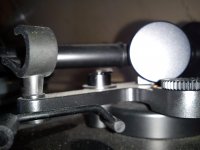
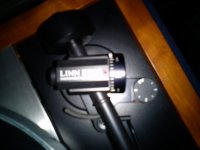
There are two adjustments visible in the picture. One is tracking weight, the other is bias? Which is which?
There are two adjustments visible in the picture. One is tracking weight, the other is bias? Which is which?
"Tracking Weight" is the tracking force applied by the recommendation of the cartridge manufacturer, or trial with test records that have a series of tracks that progressively introduce mis-tracking. It should be noted that these records typically have at least one track, often more, that no real-world cartridge can actually negotiate; so there is no need to try to have it track every one, just a reasonable level typical of real-world music LPs.
"Bias" is another term for anti-skating force. When setting the tracking force, anti-skating should be zero, so do whatever appropriate for your arm to null that force (remove the weight, turn the dial, etc).
Set tracking force, then set anti-skating. Note that anti-skating is typically somewhat imprecise but it's usually not a hugely significant force anyway. You can set it with a test record, but most people don't have one, so unless it seems out by a lot when set as to the table's (or arm's) manual, it should be close enough.
Some people believe that an incorrect bias adjustment can cause one channel of the album to wear in comparison to the other, but the small amount of force applied by anti-skating should not have that effect. It's my opinion that no anti-skating method I'm aware of is actually ideal over the whole album from start to finish anyway, if it ever does achieve an ideal amount in the first place, which is debatable. Close is good enough.
Generally speaking in my experience and opinion tracking force should be set toward the top of the cartridge manufacturer's recommendation rather than the minimal recommended setting, which some people tend to do as a matter of course. Some arms track better than others so there is no hard-and-fast number, but there is no real advantage to having it too light.
It can impact the life of the suspension of the stylus if it's too high but one has to assume the manufacture has chosen the range based on the cartridge suspension's ability to handle the recommended tracking force, so anything within the recommended range should not be "too high" in that regard. I mention it only because some cartridges are known to be weak in that area so it's something to be aware of with specific models affected only.
The reason to avoid a too low setting is that additional tracking force has minimal impact on stylus or album wear which is the commonest reason people give for setting it as light as possible, but a mis-tracking cartridge causes instant and permanent damage to the album. If you think of the stylus' path in the groove as akin to a train running on rails, which definitely causes the rail bed to move but not to be damaged, while a mis-tracking cartridge is akin to a derailment ... also known as a "train wreck".
Last edited:

There are two adjustments visible in the picture. One is tracking weight, the other is bias? Which is which?
If it's like my Ittok LVII (and it looks the same from the photo), the knob on the pivot is tracking force, the knob on the outrigger is antiskate.
OK, I just wondered if he had them the wrong way round. One knob is set to 2.5; he is measuring 2.6.
J2B: I was asking which knob is which, not which concept is which. However, thanks for your explanation.
J2B: I was asking which knob is which, not which concept is which. However, thanks for your explanation.
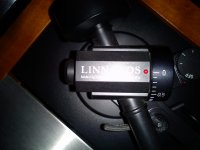
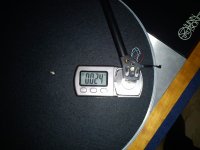
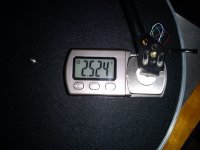
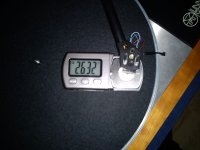
I do the following as the pics:
1. Adjusted tonearm weight 0gr horizontal to chassis
2. Antiskating adjusted to 0gr
3. Measured with precision scale with no wight at the tonearm 0.024gr
4. With 2.5 marked a t the tonearm the precision scale measure 2.632gr so adjusted to 2.524gr to avoid the error, tonearm read 2.4gr
5. Adjusted anti-skating to 2.5gr
The right question: I adjusted well the antis-kating force or not? because as per tonearm specs must be the same like tracking force cart spec 2.5gr or the 2.4gr as per tonearm shows?
Guys thanks for support.🙂
1. Adjusted tonearm weight 0gr horizontal to chassis
2. Antiskating adjusted to 0gr
3. Measured with precision scale with no wight at the tonearm 0.024gr
4. With 2.5 marked a t the tonearm the precision scale measure 2.632gr so adjusted to 2.524gr to avoid the error, tonearm read 2.4gr
5. Adjusted anti-skating to 2.5gr
The right question: I adjusted well the antis-kating force or not? because as per tonearm specs must be the same like tracking force cart spec 2.5gr or the 2.4gr as per tonearm shows?
Guys thanks for support.🙂
Attachments

Last edited:
If it's like my Ittok LVII (and it looks the same from the photo), the knob on the pivot is tracking force, the knob on the outrigger is antiskate.
Yes it's like my Linto🙂
The balance is reading incorrectly - it could be the balance needs calibration or else the magnet in the cart is throwing it off. Is it an MC cart?
That particular scale is supposed to be impervious to magnetic interactions, and the range is supposed to be 0~5gm, so assuming it's working correctly those should not be issues.
Having said that, it may not be working correctly.
I would try to confirm the scale's accuracy with a balance scale weight of 1 or 2 grams (or other known precision value) and if it checks out, use that over the arm's calibrated values (which also could be out).
If the arm is suspect, and the scale confirmed, you could simply set the arm's dial to zero, and set the tracking force by moving the counterweight alone and measuring with the scale at the stylus tip. Set the anti-skating as normal (with the dial based on your scale reading for tracking force).
Last edited:
That particular scale is supposed to be impervious to magnetic interactions, and the range is supposed to be 0~5gm, so assuming it's working correctly those should not be issues.
Having said that, it may not be working correctly.
I would try to confirm the scale's accuracy with a balance scale weight of 1 or 2 grams (or other known precision value) and if it checks out, use that over the arm's calibrated values (which also could be out).
If the arm is suspect, and the scale confirmed, you could simply set the arm's dial to zero, and set the tracking force by moving the counterweight alone and measuring with the scale at the stylus tip.
Yes it's 0-5gr, I calibrated the balance scale before measurements with the 5gr tare included in the balance
It's a good idea setting arm's dial to zero & set the tracking force by moving the counterweight with scale.😉
Attachments

Hi Merlin
It looks like your Ekos arm does apply VTF with a coil... Is it possible that the coil lost some of it´s precision in time ?
It looks like your Ekos arm does apply VTF with a coil... Is it possible that the coil lost some of it´s precision in time ?
It's a good idea setting arm's dial to zero & set the tracking force by moving the counterweight with scale.😉
I prefer to set the counterweight as near the pivot as possible to minimize inertia and than set the VTF using the coil but based on the scale information (If the scale reads correctly)
merlin el mago
Reading your response in post #9 http://www.diyaudio.com/forums/analogue-source/188819-tracking-force.html#post2568586 I understand that the issue of applying the right tracking force is no issue anymore (i.e. you don’t have to worry about it, it is O.K.).
As for this:
I would tell you, do not bother. The whole issue of proper antiskating is more complex than the effect of 0.1gr off.
If you really want to deal with it without too much hassle, follow the advice of dnsey:
http://www.diyaudio.com/forums/analogue-source/75389-think-thhow-puthhy-cat.html#post864673
Regards
George
Reading your response in post #9 http://www.diyaudio.com/forums/analogue-source/188819-tracking-force.html#post2568586 I understand that the issue of applying the right tracking force is no issue anymore (i.e. you don’t have to worry about it, it is O.K.).
As for this:
The right question: I adjusted well the anti-skating force or not? because as per tonearm specs must be the same like tracking force cart spec 2.5gr or the 2.4gr as per tonearm shows?
I would tell you, do not bother. The whole issue of proper antiskating is more complex than the effect of 0.1gr off.
If you really want to deal with it without too much hassle, follow the advice of dnsey:
http://www.diyaudio.com/forums/analogue-source/75389-think-thhow-puthhy-cat.html#post864673
Regards
George
Hey guys,
Thanks for all inputs, now I'm sure that tracking force is well adjusted.
Cheers
Felipe
Thanks for all inputs, now I'm sure that tracking force is well adjusted.
Cheers
Felipe
The tonearm's reading is incorrect. Use the force indicated on a precision stylus force gage. The tonearm applies force by creating a dynamic imbalance of torque, that is mass times distance from the pivot point. The gage in the arm assumes that the cartridge has a specific weight. If the actual weight is different, the calibration won't be correct.
The correct adjustment of the anti-skating force is performed with a record with a wide blank area midway between the lead in and lead out grooves. Place the arm so that the stylus is in the center of this area and adjust the anti skating force so that the arm does not skate inward or outward.
Regardless of the manufacturer's specifications, the only true test of adequate tracking force is to use a test record such as the Shure Audio Obstacle Course. This disc gives several samples of difficult to track tests at different modulation levels. When the cartridge tracks the highest level of all of them without distortion, the tracking force is adequate for most or all recordings.
The correct adjustment of the anti-skating force is performed with a record with a wide blank area midway between the lead in and lead out grooves. Place the arm so that the stylus is in the center of this area and adjust the anti skating force so that the arm does not skate inward or outward.
Regardless of the manufacturer's specifications, the only true test of adequate tracking force is to use a test record such as the Shure Audio Obstacle Course. This disc gives several samples of difficult to track tests at different modulation levels. When the cartridge tracks the highest level of all of them without distortion, the tracking force is adequate for most or all recordings.
That is also my opinion 😀
About tonearm reading I think that Linn calculate the TF with a specific cartridge with his specific weight so it's normal if you change the cartridge that's not have the same weight the TF varies.
- Status
- Not open for further replies.
- Home
- Source & Line
- Analogue Source
- Tracking force